EPUB · English
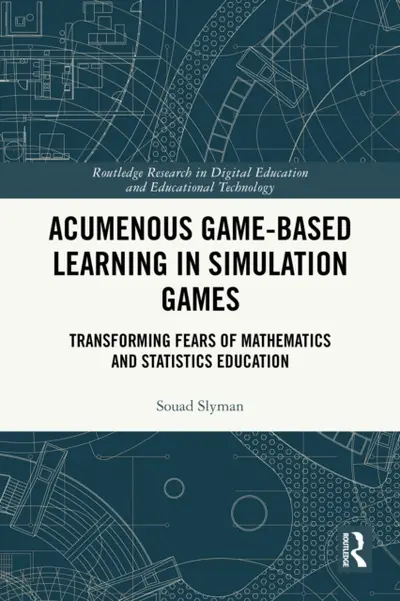
Acumenous Game-Based Learning in Simulation Games
Transforming Fears of Mathematics and Statistics Education
Price and availability
$64.99
Available in: Andorra, Austria, Australia, Belgium, Bulgaria, Canada, Switzerland, Cyprus, Czechia, Germany, Denmark, Estonia, Spain, Finland, France, United Kingdom, Guernsey, Greece, Croatia, Hungary, Ireland, Isle of Man, Iceland, Italy, Jersey, Japan, Liechtenstein, Lithuania, Luxembourg, Latvia, Monaco, Malta, Netherlands, Norway, Poland, Portugal, Romania, Sweden, Slovenia, Slovakia, San Marino, United States, Vatican City, South Africa
Stores: US, UK, Canada, EU, Australia.
Sign in to buyThe price is re-checked by the server before payment.
For personal use under the eBook licence.
- Format
- EPUB
- DRM
- Not stated by the publisher
- Language
- English
- Publisher
- Taylor & Francis
- Published
- 23 December 2024
- ISBN
- 9781040274965
- Subjects
- Education, Educational psychology, Higher & further education, tertiary education, Teaching skills & techniques, Teaching of a specific subject, Educational equipment & technology, computer-aided learning (CAL), Probability & statistics, Game theory, Engineering: general, Educational psychology, Higher education, tertiary education, Teaching skills and techniques, Teaching of a specific subject, Probability and statistics, Game theory, Engineering: general
About this book
Drawing on a comprehensive theoretical foundation encompassing socio-constructivism, social learning, and motivation, this book offers a new theoretical contribution and sheds light on the transformative power of acumenous game-based learning to reengage learners with Mathematics and Statistics Education.Foregrounding six years of research into simulation games, and exploring inquisitional and acumenous theory, the book ultimately explores the power of science and game-based technologies, applying theoretical knowledge to practice in order to reframe negative connotations associated with mathematical and statistical learning. The chapters explore maths anxiety and resilience, as well as understanding dyscalculia and its ramifications, introducing a novel theoretical framework that will redefine traditional teaching paradigms. Ultimately exploring the powerful potential of simulation games as motivational and pedagogical tools to redress the complex societal problem of negative emotions toward Mathematics and Statistics Education, readers will gain invaluable insights into unlocking new learning opportunities, paving the way for a future where mathematics and statistics become accessible, engaging, and empowering for all.This book is of benefit to postgraduate students, scholars, and academics in the fields of educational technology, mathematics education, and teaching and learning in higher education more broadly.
Bibliographic data © Gardners Books Ltd.