PDF · English
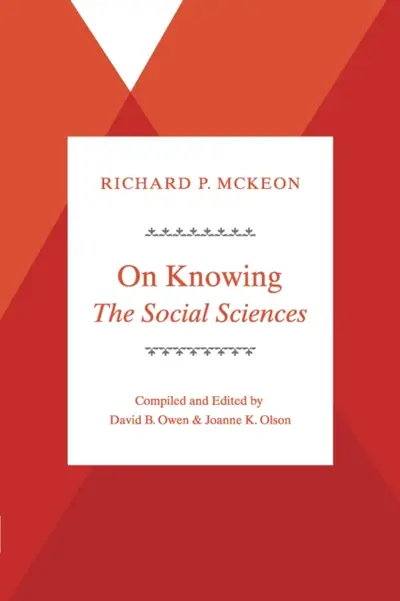
On Knowing--The Social Sciences
Price and availability
$58.99
Available in: Andorra, Austria, Australia, Belgium, Bulgaria, Canada, Switzerland, Cyprus, Czechia, Germany, Denmark, Estonia, Spain, Finland, France, United Kingdom, Guernsey, Greece, Croatia, Hungary, Ireland, Isle of Man, Iceland, Italy, Jersey, Japan, Liechtenstein, Lithuania, Luxembourg, Latvia, Monaco, Malta, Netherlands, Norway, Poland, Portugal, Romania, Sweden, Slovenia, Slovakia, San Marino, United States, Vatican City, South Africa
Stores: US, UK, Canada, EU, Australia.
Sign in to buyThe price is re-checked by the server before payment.
For personal use under the eBook licence.
- Format
- DRM
- Not stated by the publisher
- Language
- English
- Publisher
- University of Chicago Press
- Published
- 9 February 2017
- ISBN
- 9780226340357
- Subjects
- Philosophy, Western philosophy, from c 1900 -, Philosophy: epistemology & theory of knowledge, Social & political philosophy, Society & culture: general, Social theory, Society and culture: general, Philosophy, Western philosophy from c 1800, Philosophy: epistemology and theory of knowledge
About this book
As a philosopher, Richard McKeon spent his career developing Pragmatism in a new key, specifically by tracing the ways in which philosophic problems arise in fields other than philosophy-across the natural and social sciences and aesthetics-and showed the ways in which any problem, pushed back to its beginning or taken to its end, is a philosophic problem. The roots of this book, On Knowing-The Social Sciences, are traced to McKeon's classes where he blended philosophy with physics, ethics, politics, history, and aesthetics. This volume-the second in a series-leaves behind natural science themes to embrace freedom, power, and history, which, McKeon argues, lay out the whole field of human action. The authors McKeon considers-Hobbes, Machiavelli, Spinoza, Kant, and J. S. Mill-show brilliantly how philosophic methods work in action, via analyses that do not merely reduce or deconstruct meaning, but enhance those texts by reconnecting them to the active history of philosophy and to problems of ethics, politics, and history. The waves of modernism and post-modernism are receding. Philosophic pluralism is now available, fully formulated, in McKeon's work, spreading from the humanities to the social sciences.
Bibliographic data © Gardners Books Ltd.