EPUB · English
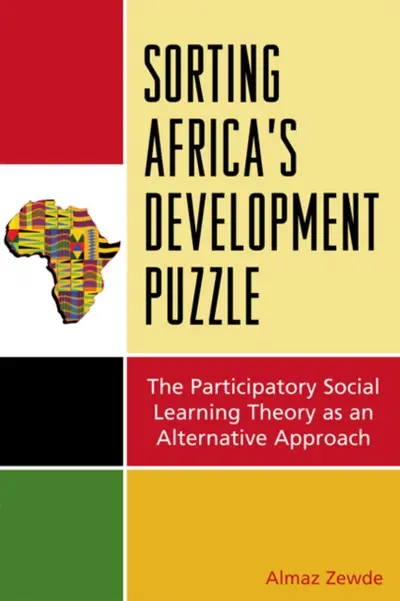
Sorting Africa's Developmental Puzzle
The Participatory Social Learning Theory as an Alternative Approach
Price and availability
$60.99
Available in: Andorra, Austria, Australia, Belgium, Bulgaria, Canada, Switzerland, Cyprus, Czechia, Germany, Denmark, Estonia, Spain, Finland, France, United Kingdom, Guernsey, Greece, Croatia, Hungary, Ireland, Isle of Man, Iceland, Italy, Jersey, Japan, Liechtenstein, Lithuania, Luxembourg, Latvia, Monaco, Malta, Netherlands, Norway, Poland, Portugal, Romania, Sweden, Slovenia, Slovakia, San Marino, United States, Vatican City, South Africa
Stores: US, UK, Canada, EU, Australia.
Sign in to buyThe price is re-checked by the server before payment.
For personal use under the eBook licence.
- Format
- EPUB
- DRM
- Not stated by the publisher
- Language
- English
- Publisher
- Bloomsbury Publishing (USA)
- Published
- 2 June 2010
- Pages
- 284
- ISBN
- 9780761849087
- Subjects
- Africa, Development studies, Philosophy, Political science & theory, Development economics & emerging economies, Political economy, Reception or Interpretation studies / Audience Theory, Political science and theory, Development economics and emerging economies, Political economy, QD
About this book
Sorting Africa's Development Puzzle: The Participatory Social Learning Theory as an Alternative Approach is a comprehensive exploration of why Africa has not managed to achieve a sustainable and self-regenerating development over the past half-century of effort. The work situates the problems of Africa's persistent underdevelopment in the practices employed by national political elites, donors, and lenders to African development that played roles in determinant policy and planning. Unlike many newly developed countries and regions, and contrary to the historical experiences of developed countries where ordinary people were full stakeholders and drivers of development, Africa's development has been top-down, expert and capital driven, mechanical, and typically externally designed. Ordinary Africans were made marginal to development. This approach to Africa's development was devoid of building the people and their institutions as the legitimate means of development. The entrusting of Africa's development to local and international elites to the exclusion of the people from decision-making and full participation, has led to grievous deficits in the formation of human and social capital, and legitimate economic, social, and political institutions for development. The book offers a studied alternative that can positively change Africa's development direction - The Participatory Social Learning Approach. The philosophical, theoretical, historical and heuristic origins of this alternative are offered in detail within this book.
Bibliographic data © Gardners Books Ltd.