EPUB · English
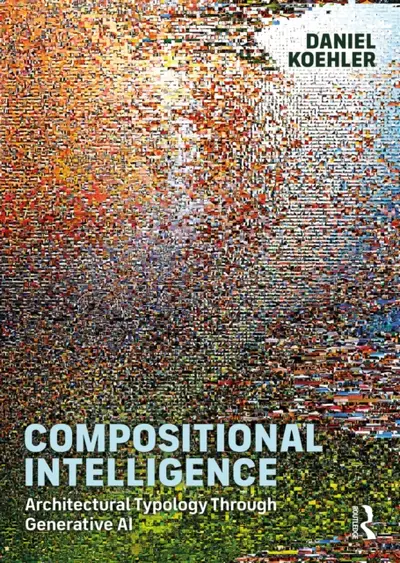
Compositional Intelligence
Architectural Typology Through Generative AI
Price and availability
$48.99
Available in: Andorra, Austria, Australia, Belgium, Bulgaria, Canada, Switzerland, Cyprus, Czechia, Germany, Denmark, Estonia, Spain, Finland, France, United Kingdom, Guernsey, Greece, Croatia, Hungary, Ireland, Isle of Man, Iceland, Italy, Jersey, Japan, Liechtenstein, Lithuania, Luxembourg, Latvia, Monaco, Malta, Netherlands, Norway, Poland, Portugal, Romania, Sweden, Slovenia, Slovakia, San Marino, United States, Vatican City, South Africa
Stores: US, UK, Canada, EU, Australia.
Sign in to buyThe price is re-checked by the server before payment.
For personal use under the eBook licence.
- Format
- EPUB
- DRM
- Not stated by the publisher
- Language
- English
- Publisher
- Taylor & Francis
- Published
- 12 September 2025
- ISBN
- 9781040442470
- Subjects
- Architecture: professional practice, City & town planning - architectural aspects, Urban & municipal planning, Civil engineering, surveying & building, Computer-aided design (CAD), Artificial intelligence, Theory of architecture, City and town planning: architectural aspects, Artificial intelligence (AI)
About this book
*With a foreword by Mario Carpo*Given the extensive data sources represented by urban environments, this book investigates the potential of architecting for cities using large-scale models - the technological underpinning of Generative AI. Koehler examines Large Language Models (LLMs) in relation to architectural questions of typology - those critical junctures where architecture engages with the city itself. Typology becomes the interface between an AI model and its modeled audiences, represented languages, and scales of operation.The investigation reveals how LLMs represent a fundamental shift from comprehending discrete elements to understanding entire languages - introducing a stochastic perspective that transforms how we read and shape urban reality. At the heart of this framework lies the concept of "e;inductive types"e; - threshold interfaces that superpose multiple value regimes and actively reconfigure themselves in response to changing urban conditions. By treating architecture as a form of representational materialism rather than a fixed language, designers can engage with complex urban systems while maintaining critical agency.This approach envisions architecture as an embedding of languages, where buildings become processors of information that compute through their spatial arrangements. The synthetic knowledge produced by LLMs enables access to plural values and stakeholder perspectives, allowing architects to participate in broader material ecologies through computational superposition rather than traditional dialectical methods.Providing a robust theoretical framework as well as practical insights into how architects can adapt their notational tools and design processes to embrace AI, this will be an essential read for any practicing or researching architect or urban designer interested in the implications of AI on the built environment.
Bibliographic data © Gardners Books Ltd.