PDF · English
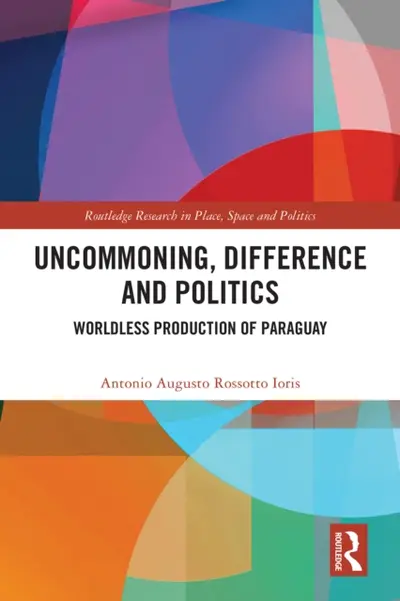
Uncommoning, Difference and Politics
Worldless Production of Paraguay
Price and availability
$64.99
Available in: Andorra, Austria, Australia, Belgium, Bulgaria, Canada, Switzerland, Cyprus, Czechia, Germany, Denmark, Estonia, Spain, Finland, France, United Kingdom, Guernsey, Greece, Croatia, Hungary, Ireland, Isle of Man, Iceland, Italy, Jersey, Japan, Liechtenstein, Lithuania, Luxembourg, Latvia, Monaco, Malta, Netherlands, Norway, Poland, Portugal, Romania, Sweden, Slovenia, Slovakia, San Marino, United States, Vatican City, South Africa
Stores: US, UK, Canada, EU, Australia.
Sign in to buyThe price is re-checked by the server before payment.
For personal use under the eBook licence.
- Format
- DRM
- Not stated by the publisher
- Language
- English
- Publisher
- Taylor & Francis
- Published
- 30 December 2024
- ISBN
- 9781040304686
- Subjects
- Paraguay, Sociology, Human geography, Regional geography, Paraguay, Indigenous people: governance and politics, Agriculture, agribusiness and food production industries, Development and environmental geography
About this book
The book presents a reinterpretation of the meaning and practices of uncommoning. It provides a critical reflection on the frontiers of the modern world where uncommoning is often the key driving- force underpinning a deceitful democracy and an exclusionary socio-economy. Uncommoning is a socio-spatial process of othering, grabbing and reordering that particularly impacts indigenous peoples.This book revisits classical, contemporary and decolonial literature, as well as documents, reports and archival data, to analyse the Paraguayan case of uncommoning. It examines how these processes have deep roots in the shortcomings of Western thinking, including religious, juridical and moral doctrines. The book also demonstrates that Europe has major responsibilities and cannot be removed from the search for responses and alternatives. After a detailed theoretical elaboration, informed primary by Hegel's socio-spatial sensibilities, the book empirically analyses the 'worldless' production of Paraguay as a country with a fragile sovereignty and whose development is, more than anything else, highly subtractive.The text will be of interest to scholars and researchers in development, indigenous studies, decolonisation, human geography, agribusiness, South American studies, as well as policy-makers in international development agencies and NGOs.
Bibliographic data © Gardners Books Ltd.