PDF · English
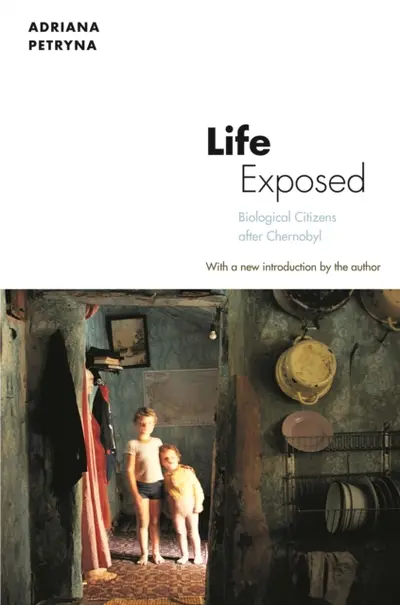
Life Exposed
Biological Citizens after Chernobyl
Price and availability
$40.99
Available in: Andorra, Austria, Australia, Belgium, Bulgaria, Canada, Switzerland, Cyprus, Czechia, Germany, Denmark, Estonia, Spain, Finland, France, United Kingdom, Guernsey, Greece, Croatia, Hungary, Ireland, Isle of Man, Iceland, Italy, Jersey, Japan, Liechtenstein, Lithuania, Luxembourg, Latvia, Monaco, Malta, Netherlands, Norway, Poland, Portugal, Romania, Sweden, Slovenia, Slovakia, San Marino, United States, Vatican City, South Africa
Stores: US, UK, Canada, EU, Australia.
Sign in to buyThe price is re-checked by the server before payment.
For personal use under the eBook licence.
- Format
- DRM
- Not stated by the publisher
- Language
- English
- Publisher
- Princeton University Press
- Published
- 20 March 2013
- ISBN
- 9781400845095
- Subjects
- Russia, Ukraine, Social impact of disasters, Nuclear issues, Social impact of environmental issues, Russia, USSR, Soviet Union, Health, illness or addiction: social aspects, Anthropology, Social and cultural anthropology, History of other geographical groupings and regions or specific cultures / societies / groups / peoples
About this book
On April 26, 1986, Unit Four of the Chernobyl nuclear reactor exploded in then Soviet Ukraine. More than 3.5 million people in Ukraine alone, not to mention many citizens of surrounding countries, are still suffering the effects. Life Exposed is the first book to comprehensively examine the vexed political, scientific, and social circumstances that followed the disaster. Tracing the story from an initial lack of disclosure to post-Soviet democratizing attempts to compensate sufferers, Adriana Petryna uses anthropological tools to take us into a world whose social realities are far more immediate and stark than those described by policymakers and scientists. She asks: What happens to politics when state officials fail to inform their fellow citizens of real threats to life? What are the moral and political consequences of remedies available in the wake of technological disasters? Through extensive research in state institutions, clinics, laboratories, and with affected families and workers of the so-called Zone, Petryna illustrates how the event and its aftermath have not only shaped the course of an independent nation but have made health a negotiated realm of entitlement. She tracks the emergence of a "e;biological citizenship"e; in which assaults on health become the coinage through which sufferers stake claims for biomedical resources, social equity, and human rights. Life Exposed provides an anthropological framework for understanding the politics of emergent democracies, the nature of citizenship claims, and everyday forms of survival as they are interwoven with the profound changes that accompanied the collapse of the Soviet Union.
Bibliographic data © Gardners Books Ltd.