PDF · English
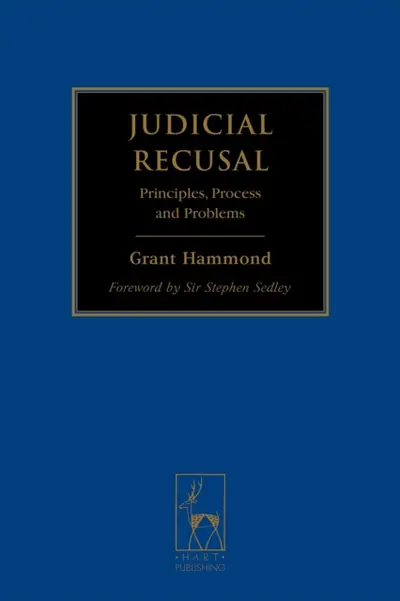
Judicial Recusal
Principles, Process and Problems
Price and availability
$133.99
Available in: Andorra, Austria, Australia, Belgium, Bulgaria, Canada, Switzerland, Cyprus, Czechia, Germany, Denmark, Estonia, Spain, Finland, France, United Kingdom, Guernsey, Greece, Croatia, Hungary, Ireland, Isle of Man, Iceland, Italy, Jersey, Japan, Liechtenstein, Lithuania, Luxembourg, Latvia, Monaco, Malta, Netherlands, Norway, Poland, Portugal, Romania, Sweden, Slovenia, Slovakia, San Marino, United States, Vatican City, South Africa
Stores: US, UK, Canada, EU, Australia.
Sign in to buyThe price is re-checked by the server before payment.
For personal use under the eBook licence.
- Format
- DRM
- Not stated by the publisher
- Language
- English
- Publisher
- Bloomsbury Publishing
- Published
- 27 July 2009
- Pages
- 208
- ISBN
- 9781847315182
- Subjects
- Constitutional & administrative law, Constitutional and administrative law: general
About this book
The doctrine of judicial recusal enables - and may require - a judge who is lawfully appointed to hear and determine a case to stand down from that case, leaving its disposition to another colleague or colleagues. The subject is one of considerable import and moment, not only to 'insiders' in the judiciary, but also to litigants and their lawyers. Understanding the principles which guide recusal is also to understand the fundamentals of judging in the common law tradition. The subject is therefore of considerable interest both at practical and theoretical levels, for it tells us most of what we need to know about what it means "e;to be a judge"e; and what the discharge of that constitutional duty entails. Unsurprisingly therefore, the subject has attracted controversy, and some of the most savage criticisms ever directed at particular judges.The book commences with an introduction which is followed by an analysis of the essential features of the law, the legal principles (common-law origins, the law today in the USA, UK and Commonwealth) and the difficulties which currently arise in the cases and by operation of statute. The third part looks at process, including waiver, necessity, appellate review, and final appeals. Three specific problem areas (judicial misconduct in court, prior viewpoints, and unconcious bias) are then discussed. The book ends with the author's reflections on future developments and possible reforms of recusal law.
Bibliographic data © Gardners Books Ltd.