PDF · English
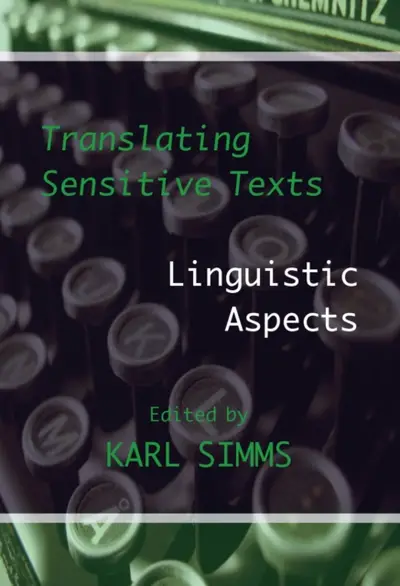
Translating Sensitive Texts
Linguistic Aspects
Price and availability
$248.99
Available in: Andorra, Austria, Australia, Belgium, Bulgaria, Canada, Switzerland, Cyprus, Czechia, Germany, Denmark, Estonia, Spain, Finland, France, United Kingdom, Guernsey, Greece, Croatia, Hungary, Ireland, Isle of Man, Iceland, Italy, Jersey, Japan, Liechtenstein, Lithuania, Luxembourg, Latvia, Monaco, Malta, Netherlands, Norway, Poland, Portugal, Romania, Sweden, Slovenia, Slovakia, San Marino, United States, Vatican City, South Africa
Stores: US, UK, Canada, EU, Australia.
Sign in to buyThe price is re-checked by the server before payment.
For personal use under the eBook licence.
- Format
- DRM
- Not stated by the publisher
- Language
- English
- Publisher
- Brill
- Published
- 4 July 2022
- ISBN
- 9789004485884
- Subjects
- Literacy, Translation & interpretation, Translation and language interpretation
About this book
This volume brings together twenty-two of the world's leading translation and interpreting theorists, to address the issue of sensitivity in translation. Whether in novels or legal documents, the Bible or travel brochures, in translating ancient texts or providing simultaneous interpretation, sensitive subject-matter, contentious modes of expression and the sensibilities of the target audience are the biggest obstacles to acceptance of the translator's work. The contributors bring to bear a wide variety of approaches - generative, cognitive, lexical and functional - in confronting this problem, and in negotiating the competing claims of source cultures and target cultures in the areas of cultural, political, religious and sexual sensitivity. All of the articles are presented here for the first time, and in his Introduction Karl Simms gives an overview of the philosophical and linguistic questions which have motivated translators of sensitive texts through the ages. This book will be of interest to all working translators and interpreters, and to teachers of translation theory and practice.
Bibliographic data © Gardners Books Ltd.