EPUB · English
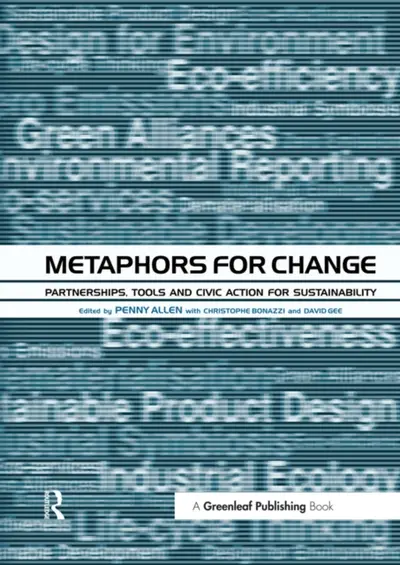
Metaphors for Change
Partnerships, Tools and Civic Action for Sustainability
Price and availability
$51.99
Available in: Andorra, Austria, Australia, Belgium, Bulgaria, Canada, Switzerland, Cyprus, Czechia, Germany, Denmark, Estonia, Spain, Finland, France, United Kingdom, Guernsey, Greece, Croatia, Hungary, Ireland, Isle of Man, Iceland, Italy, Jersey, Japan, Liechtenstein, Lithuania, Luxembourg, Latvia, Monaco, Malta, Netherlands, Norway, Poland, Portugal, Romania, Sweden, Slovenia, Slovakia, San Marino, United States, Vatican City, South Africa
Stores: US, UK, Canada, EU, Australia.
Sign in to buyThe price is re-checked by the server before payment.
For personal use under the eBook licence.
- Format
- EPUB
- DRM
- Not stated by the publisher
- Language
- English
- Publisher
- Taylor & Francis
- Published
- 29 September 2017
- ISBN
- 9781351282420
- Subjects
- Central government policies, Development economics & emerging economies, Business strategy, Sustainability, International relations, Business and the environment; sustainable approaches to business, Sustainability
About this book
How can we get from where we are to where we want to be? Metaphors for Change attempts to answer this question and provide a roadmap for sustainability by bringing together the thoughts of a unique collection of leading change agents from business, government and academia. Environmental questions have previously been dealt with metaphorically, by catastrophism or manicheism (zero growth; Malthusianism, Deep Ecology; "e;man is the enemy"e;; less is more). These metaphors have had limited impact because they have failed to connect with the mainstream of cultural, political, and business ideas. This book examines a number of new metaphors - and related partnerships, tools and action - which appear to have greater possibilities for the world in which we now live. The editors argue that Metaphors for Change can deliver to the public and to decision-makers new perceptions ("e;structured knowledge"e;) that can help interpret the past and the present, and help us forge the future. The wider the gap between the "e;now"e; and the "e;necessary"e;, the stronger the bridging perceptions have to be in order to break through barriers of fear and conservatism. Some of the concepts considered are: sustainable development; the polluter pays principle; the precautionary principle; eco-efficiency; eco-effectiveness; life-cycle assessment; design for the environment; eco-services; dematerialization; industrial symbiosis; industrial ecology; and zero emissions. There are of course other useful metaphors on the horizon, some of them included in this book. Including key contributions from the ground-breaking conferences ECO 97 and ECO 99, along with other specially commissioned and reprinted pieces, Metaphors for Change provides a treasure chest of new ideas, innovations and action. Accessible and forward-thinking, it will prove indispensable both as a student learning tool and as a panoramic overview of the sustainability metaphors key thinkers believe we should be putting into practice.
Bibliographic data © Gardners Books Ltd.