PDF · English
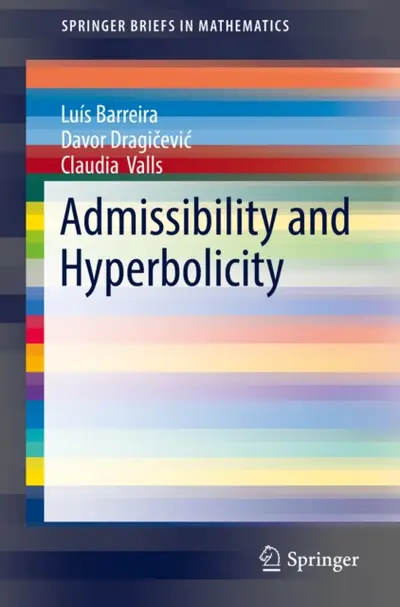
Admissibility and Hyperbolicity
Price and availability
$60.99
Available in: Andorra, Austria, Australia, Belgium, Bulgaria, Canada, Switzerland, Cyprus, Czechia, Germany, Denmark, Estonia, Spain, Finland, France, United Kingdom, Guernsey, Greece, Croatia, Hungary, Ireland, Isle of Man, Iceland, Italy, Jersey, Japan, Liechtenstein, Lithuania, Luxembourg, Latvia, Monaco, Malta, Netherlands, Norway, Poland, Portugal, Romania, Sweden, Slovenia, Slovakia, San Marino, United States, Vatican City, South Africa
Stores: US, UK, Canada, EU, Australia.
Sign in to buyThe price is re-checked by the server before payment.
For personal use under the eBook licence.
- Format
- DRM
- Not stated by the publisher
- Language
- English
- Publisher
- Springer International Publishing
- Published
- 2 May 2018
- ISBN
- 9783319901107
- Subjects
- Cybernetics & systems theory, Calculus & mathematical analysis, Differential calculus & equations, Nonlinear science, Cybernetics and systems theory, Differential calculus and equations
About this book
This book gives a comprehensive overview of the relationship between admissibility and hyperbolicity. Essential theories and selected developments are discussed with highlights to applications. The dedicated readership includes researchers and graduate students specializing in differential equations and dynamical systems (with emphasis on hyperbolicity) who wish to have a broad view of the topic and working knowledge of its techniques. The book may also be used as a basis for appropriate graduate courses on hyperbolicity; the pointers and references given to further research will be particularly useful.The material is divided into three parts: the core of the theory, recent developments, and applications. The first part pragmatically covers the relation between admissibility and hyperbolicity, starting with the simpler case of exponential contractions. It also considers exponential dichotomies, both for discrete and continuous time, and establishes corresponding results buildingon the arguments for exponential contractions. The second part considers various extensions of the former results, including a general approach to the construction of admissible spaces and the study of nonuniform exponential behavior. Applications of the theory to the robustness of an exponential dichotomy, the characterization of hyperbolic sets in terms of admissibility, the relation between shadowing and structural stability, and the characterization of hyperbolicity in terms of Lyapunov sequences are given in the final part.
Bibliographic data © Gardners Books Ltd.