EPUB · English
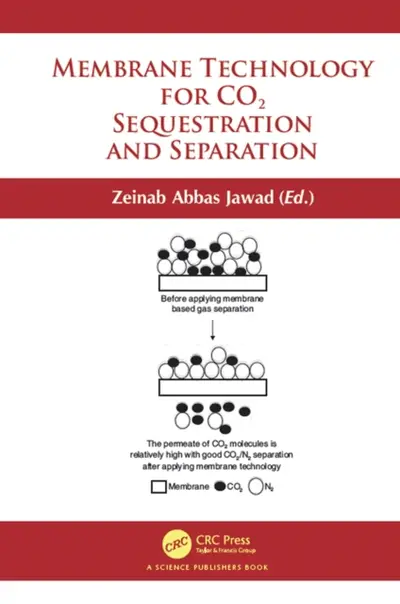
Membrane Technology for CO2 Sequestration
Price and availability
$72.99
Available in: Andorra, Austria, Australia, Belgium, Bulgaria, Canada, Switzerland, Cyprus, Czechia, Germany, Denmark, Estonia, Spain, Finland, France, United Kingdom, Guernsey, Greece, Croatia, Hungary, Ireland, Isle of Man, Iceland, Italy, Jersey, Japan, Liechtenstein, Lithuania, Luxembourg, Latvia, Monaco, Malta, Netherlands, Norway, Poland, Portugal, Romania, Sweden, Slovenia, Slovakia, San Marino, United States, Vatican City, South Africa
Stores: US, UK, Canada, EU, Australia.
Sign in to buyThe price is re-checked by the server before payment.
For personal use under the eBook licence.
- Format
- EPUB
- DRM
- Not stated by the publisher
- Language
- English
- Publisher
- CRC Press
- Published
- 26 March 2019
- ISBN
- 9781351380805
- Subjects
- Chemical engineering, Process engineering technology and techniques, Engineering applications of polymers and composites, Fossil fuel technologies
About this book
This book addresses the fundamentals of CO2 storage for long-term sequestration in a subsurface geologic formation. In general, membrane gas separation can find a large room of application in flue gas. To achieve the development of this technology on a larger scale than which is possible in the lab we have to use membrane engineering. Consequently, greater emphasis is placed on novel materials for gas separation. Possible design strategies and role of novel materials are discussed. Additionally, the latest progress in design and preparation of asymmetric membranes for natural gas purification are highlighted. In fact, further development should focus on module and process design in order to bring gas separation membrane technology into commercial application. Therefore, the keys issues to propel current research towards industrial application are examined. Besides, the feasibility of implementing polyimide membrane for CO2 removal under real industrial conditions and its economic viability are highlighted. In order to exhibit excellent film-forming properties, zeolite membrane and cellulose acetate butyrate membrane areaddressed. Interestingly, it was found that the most accurate theoretical three-phase model is arguably revised Pal model with average percentage error of 0.74%.
Bibliographic data © Gardners Books Ltd.