PDF · English
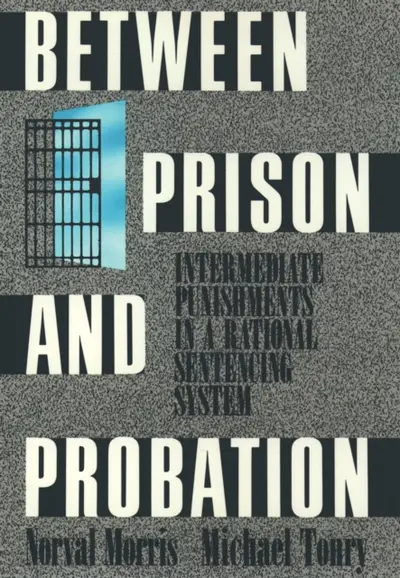
Between Prison and Probation
Intermediate Punishments in a Rational Sentencing System
Price and availability
$17.99
Available in: Andorra, Austria, Australia, Belgium, Bulgaria, Canada, Switzerland, Cyprus, Czechia, Germany, Denmark, Estonia, Spain, Finland, France, United Kingdom, Guernsey, Greece, Croatia, Hungary, Ireland, Isle of Man, Iceland, Italy, Jersey, Japan, Liechtenstein, Lithuania, Luxembourg, Latvia, Monaco, Malta, Netherlands, Norway, Poland, Portugal, Romania, Sweden, Slovenia, Slovakia, San Marino, United States, Vatican City, South Africa
Stores: US, UK, Canada, EU, Australia.
Sign in to buyThe price is re-checked by the server before payment.
For personal use under the eBook licence.
- Format
- DRM
- Not stated by the publisher
- Language
- English
- Publisher
- Oxford University Press
- Published
- 12 September 1991
- ISBN
- 9780195361193
- Subjects
- Social impact of disasters, Crime & criminology, Penology & punishment, Prisons, Central government policies, JBFF, Crime and criminology, Penology and punishment, Central / national / federal government policies
About this book
Across the country prisons are jammed to capacity, and in extreme cases, barges and mobile homes are used to stem the overflow. Probation officers in some cities have caseloads of 200 and more--hardly a manageable number of offenders to track and supervise. And with about one million people in prison and jail, and two and a half million on probation, it is clear we are experiencing a crisis in our penal system. In Between Prison and Probation, Norval Morris and Michael Tonry, two of the nation's leading criminologists, offer an important and timely strategy for alleviating these problems. They argue that our overwhelmed corrections system cannot cope with the flow of convicted offenders because the two extremes of punishment--imprisonment and probation--are both used excessively, with a near-vacuum of useful punishments in between. Morris and Tonry propose instead a comprehensive program that relies on a range of punishment including fines and other financial sanctions, community service, house arrest, intensive probation, closely supervised treatment programs for drugs, alcohol and mental illness, and electronic monitoring of movement. Used in rational combinations, these "e;intermediate"e; punishments would better serve the community than our present polarised choice. Serious consideration of these punishments has been hindered by the widespread perception that they are therapeutic rather than punitive. The reality, however, Morris and Tonry argue, "e;is that the American criminal justice system is both too severe and too lenient--almost randomly."e; Systematically implemented and rigorously enforced, intermediate punishments can "e;better and more economically serve the community, the victim, and the criminal than the prison terms and probation orders they supplant."e; Between Prison and Probation goes beyond mere advocacy of an increasing use of interdediate punishments; the book also addresses the difficult task of fitting these punishments into a comprehensive, fair and community-protective sentencing system.
Bibliographic data © Gardners Books Ltd.