EPUB · English
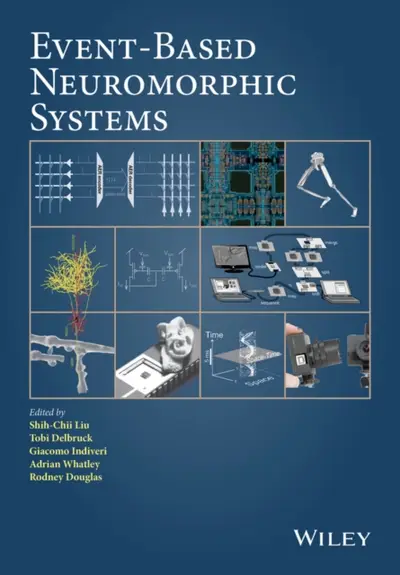
Event-Based Neuromorphic Systems
Price and availability
$117.99
Available in: Andorra, Austria, Australia, Belgium, Bulgaria, Canada, Switzerland, Cyprus, Czechia, Germany, Denmark, Estonia, Spain, Finland, France, United Kingdom, Guernsey, Greece, Croatia, Hungary, Ireland, Isle of Man, Iceland, Italy, Jersey, Japan, Liechtenstein, Lithuania, Luxembourg, Latvia, Monaco, Malta, Netherlands, Norway, Poland, Portugal, Romania, Sweden, Slovenia, Slovakia, San Marino, United States, Vatican City, South Africa
Stores: US, UK, Canada, EU, Australia.
Sign in to buyThe price is re-checked by the server before payment.
For personal use under the eBook licence.
- Format
- EPUB
- DRM
- Not stated by the publisher
- Language
- English
- Publisher
- Wiley
- Published
- 24 December 2014
- ISBN
- 9781118927625
- Subjects
- Electronics & communications engineering, Circuits & components, Computer science, Electronics and communications engineering, Electronics: circuits and components, Computer science
About this book
Neuromorphic electronic engineering takes its inspiration from the functioning of nervous systems to build more power efficient electronic sensors and processors. Event-based neuromorphic systems are inspired by the brain's efficient data-driven communication design, which is key to its quick responses and remarkable capabilities. This cross-disciplinary text establishes how circuit building blocks are combined in architectures to construct complete systems. These include vision and auditory sensors as well as neuronal processing and learning circuits that implement models of nervous systems. Techniques for building multi-chip scalable systems are considered throughout the book, including methods for dealing with transistor mismatch, extensive discussions of communication and interfacing, and making systems that operate in the real world. The book also provides historical context that helps relate the architectures and circuits to each other and that guides readers to the extensive literature. Chapters are written by founding experts and have been extensively edited for overall coherence. This pioneering text is an indispensable resource for practicing neuromorphic electronic engineers, advanced electrical engineering and computer science students and researchers interested in neuromorphic systems. Key features: Summarises the latest design approaches, applications, and future challenges in the field of neuromorphic engineering. Presents examples of practical applications of neuromorphic design principles. Covers address-event communication, retinas, cochleas, locomotion, learning theory, neurons, synapses, floating gate circuits, hardware and software infrastructure, algorithms, and future challenges.
Bibliographic data © Gardners Books Ltd.