PDF · English
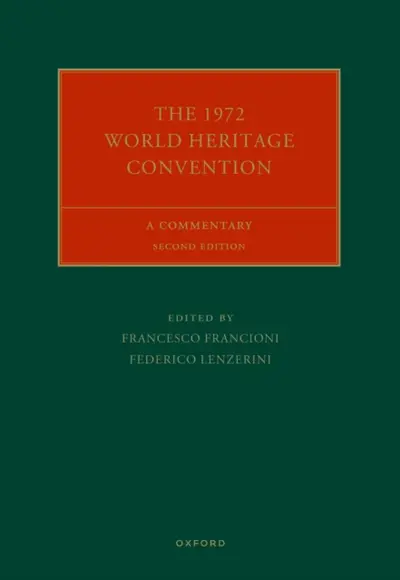
1972 World Heritage Convention
A Commentary
Price and availability
$156.99
Available in: Andorra, Austria, Australia, Belgium, Bulgaria, Canada, Switzerland, Cyprus, Czechia, Germany, Denmark, Estonia, Spain, Finland, France, United Kingdom, Guernsey, Greece, Croatia, Hungary, Ireland, Isle of Man, Iceland, Italy, Jersey, Japan, Liechtenstein, Lithuania, Luxembourg, Latvia, Monaco, Malta, Netherlands, Norway, Poland, Portugal, Romania, Sweden, Slovenia, Slovakia, San Marino, United States, Vatican City, South Africa
Stores: US, UK, Canada, EU, Australia.
Sign in to buyThe price is re-checked by the server before payment.
For personal use under the eBook licence.
- Format
- DRM
- Not stated by the publisher
- Language
- English
- Publisher
- Oxford University Press
- Published
- 16 February 2024
- ISBN
- 9780198877455
- Subjects
- Indigenous peoples, Social & cultural anthropology, ethnography, International institutions, Treaties & other sources of international law, International environmental law, International human rights law, Indigenous peoples / Indigeneity, Social and cultural anthropology, International institutions / intergovernmental organizations, Public international law: treaties and other sources, Public international law: environment, Public international law: human rights
About this book
Almost fifty years have passed since the adoption of the Convention Concerning the Protection of the World Cultural and Natural Heritage (the UNESCO World Heritage Convention). With its 194 States Parties, it is the most widely ratified convention within the family of UNESCO treaties on the protection of cultural heritage. The success of this Convention and its almost universal acceptance by the international community of states is due to the great appeal that recognising certain properties as "e;world heritage"e; has for national governments. Since the publication of the first Commentary, new problems have arisen in the management of world heritage sites. It has become increasingly difficult to properly monitor the conservation of the ever-growing mass of sites inscribed in the World Heritage List, and to resolve disputes over the formal designation of contested world heritage properties - a problem that has led to the withdrawal of the United States and Israel from UNESCO. New frontiers are now being explored for the expansion of the world heritage idea over marine areas beyond national jurisdiction, and the monopoly of the State in the identification, delineation, and presentation of world heritage properties is being increasingly challenged in the name of indigenous peoples' rights and by local communities claiming ownership over contested cultural sites. At the same time, the regime of world heritage protection has infiltrated other areas of international law, especially international economic law, investment arbitration, and the area of international criminal law. This second edition critically examines the World Heritage Convention against this dynamic evolution of international heritage law to help academics, lawyers, diplomats, and officials interpret and apply the norms of the Convention after half a century of uninterrupted implementing practice by State Parties and Treaty Bodies.
Bibliographic data © Gardners Books Ltd.