PDF · English
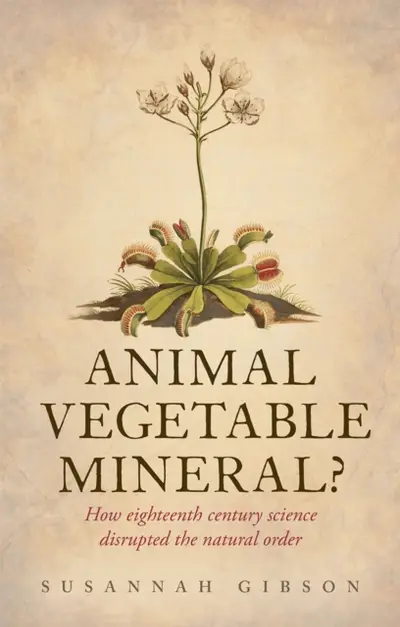
Animal, Vegetable, Mineral?
How eighteenth-century science disrupted the natural order
Price and availability
$18.99
Available in: Andorra, Austria, Australia, Belgium, Bulgaria, Canada, Switzerland, Cyprus, Czechia, Germany, Denmark, Estonia, Spain, Finland, France, United Kingdom, Guernsey, Greece, Croatia, Hungary, Ireland, Isle of Man, Iceland, Italy, Jersey, Japan, Liechtenstein, Lithuania, Luxembourg, Latvia, Monaco, Malta, Netherlands, Norway, Poland, Portugal, Romania, Sweden, Slovenia, Slovakia, San Marino, United States, Vatican City, South Africa
Stores: US, UK, Canada, EU, Australia.
Sign in to buyThe price is re-checked by the server before payment.
For personal use under the eBook licence.
- Format
- DRM
- Not stated by the publisher
- Language
- English
- Publisher
- Oxford University Press
- Published
- 23 July 2015
- ISBN
- 9780191015236
- Subjects
- c 1700 to c 1800, General & world history, Modern history to 20th century: c 1700 to c 1900, History of science, Biology, life sciences, History, History of science, Biology, life sciences
About this book
Since the time of Aristotle, there had been a clear divide between the three kingdoms of animal, vegetable, and mineral. But by the eighteenth century, biological experiments, and the wide range of new creatures coming to Europe from across the world, challenged these neat divisions. Abraham Trembley found that freshwater polyps grew into complete individuals when cut. This shocking discovery raised deep questions: was it a plant or an animal? And this was not the only conundrum. What of coral? Was it a rock or a living form? Did plants have sexes, like animals? The boundaries appeared to blur. And what did all this say about the nature of life itself? Were animals and plants soul-less, mechanical forms, as Descartes suggested? The debates raging across science played into some of the biggest and most controversial issues of Enlightenment Europe. In this book, Susannah Gibson explains how a study of pond slime could cause people to question the existence of the soul; observation of eggs could make a man doubt that God had created the world; how the discovery of the Venus fly-trap was linked to the French Revolution; and how interpretations of fossils could change our understanding of the Earth's history. Using rigorous historical research, and a lively and readable style, this book vividly captures the big concerns of eighteenth-century science. And the debates concerning the divisions of life did not end there; they continue to have resonances in modern biology.
Bibliographic data © Gardners Books Ltd.