PDF · English
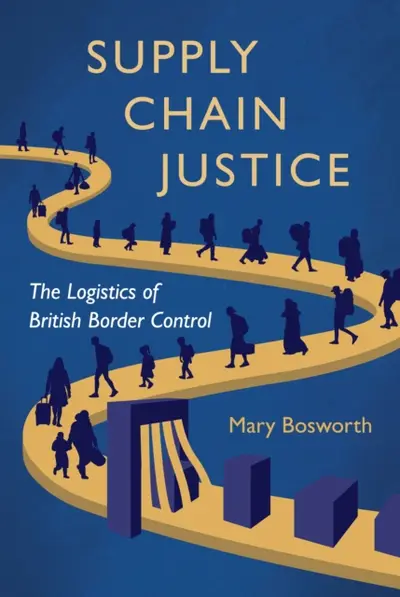
Supply Chain Justice
The Logistics of British Border Control
Price and availability
$40.99
Available in: Andorra, Austria, Australia, Belgium, Bulgaria, Canada, Switzerland, Cyprus, Czechia, Germany, Denmark, Estonia, Spain, Finland, France, United Kingdom, Guernsey, Greece, Croatia, Hungary, Ireland, Isle of Man, Iceland, Italy, Jersey, Japan, Liechtenstein, Lithuania, Luxembourg, Latvia, Monaco, Malta, Netherlands, Norway, Poland, Portugal, Romania, Sweden, Slovenia, Slovakia, San Marino, United States, Vatican City, South Africa
Stores: US, UK, Canada, EU, Australia.
Sign in to buyThe price is re-checked by the server before payment.
For personal use under the eBook licence.
- Format
- DRM
- Not stated by the publisher
- Language
- English
- Publisher
- Princeton University Press
- Published
- 17 December 2024
- ISBN
- 9780691259925
- Subjects
- United Kingdom, Great Britain, Society & culture: general, Refugees & political asylum, Migration, immigration & emigration, Political economy, Immigration law, United Kingdom, Great Britain, Society and culture: general, Refugees and political asylum, Migration, immigration and emigration, Political economy, Immigration law
About this book
How the UK's immigration detention and deportation system turns people into monetized, measurable units on a supply chain In the UK's fully outsourced ';immigration detainee escorting system,' private sector security employees detain, circulate and deport foreign national citizens. Run and organized like a supply chain, this system dehumanises those who are detained and deported, treating them as if they were packages to be moved from place to place and relying on poorly paid, minimally trained staff to do so. In Supply Chain Justice, Mary Bosworth offers the first empirically grounded, scholarly analysis of the British detention and deportation system. Drawing on four years of extensive ethnographic research, Bosworth examines what keeps the system in place and whether it might be effectively challenged.Told by a senior manager that ';this is a logistics business,' Bosworth documents how the public and private sectors have built a supply chain in which people's humanity is transformed both symbolically and tangibly through administrative processes and bureaucracy into monetized, measurable units. Like all logistics, the system has failure built into it. The contract does not seek to eradicate risk but rather to manage it, determining responsibility and apportioning a financial value to such ';failures' as delay, escape, aborted flight or death in custody. Front-line workers and managers depoliticise and normalise their efforts by casting their duties in familiar bureaucratic terms, with targets, ';service level agreements' and ';key performance indicators.' Focusing on first-hand accounts from workers and lengthy observation and document analysis, Bosworth explores the impact of border logistics in order to ask what it would take to build inclusive infrastructures rather than those designed to exclude.
Bibliographic data © Gardners Books Ltd.