EPUB · English
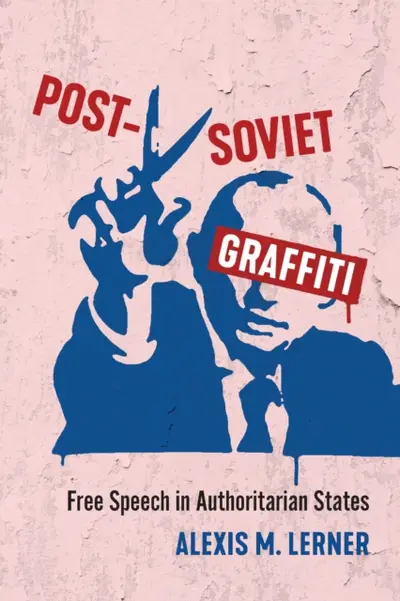
Post-Soviet Graffiti
Free Speech in Authoritarian States
Price and availability
$29.99
Available in: Andorra, Austria, Australia, Belgium, Bulgaria, Canada, Switzerland, Cyprus, Czechia, Germany, Denmark, Estonia, Spain, Finland, France, United Kingdom, Guernsey, Greece, Croatia, Hungary, Ireland, Isle of Man, Iceland, Italy, Jersey, Japan, Liechtenstein, Lithuania, Luxembourg, Latvia, Monaco, Malta, Netherlands, Norway, Poland, Portugal, Romania, Sweden, Slovenia, Slovakia, San Marino, United States, Vatican City, South Africa
Stores: US, UK, Canada, EU, Australia.
Sign in to buyThe price is re-checked by the server before payment.
For personal use under the eBook licence.
- Format
- EPUB
- DRM
- Not stated by the publisher
- Language
- English
- Publisher
- University of Toronto Press
- Published
- 18 March 2025
- Pages
- 240
- ISBN
- 9781487537135
- Subjects
- EU (European Union), Art treatments & subjects, Jewish studies, Social & cultural anthropology, ethnography, Central government policies, EU & European institutions, EU (European Union), The visual, decorative or fine arts: treatments and subjects, JBSR, Social and cultural anthropology, Central / national / federal government policies, JPSN
About this book
For more than a decade, Alexis Lerner combed the alleyways, underpasses, and public squares of cities once under communist rule, from Berlin in the west to Vladivostok in the east, recording thousands of cases of critical and satirical political street art and cataloging these artworks linguistically and thematically across space and time. Complemented by first-hand interviews with leading artists, activists, and politicians from across the region, Post-Soviet Graffiti provides theoretical reflection on public space as a site for political action, a semiotic reading of signs and symbols, and street art as a form of text.The book answers the question of how we conceptualize avenues of dissent under authoritarian rule by showing how contemporary graffiti functions not only as a popular public aesthetic, but also as a mouthpiece of political sentiment, especially within the post-Soviet region and post-communist Europe. A purposefully anonymous and accessible artform, graffiti is an effective tool for circumventing censorship and expressing political views. This is especially true for marginalized populations and for those living in otherwise closed and censored states.Post-Soviet Graffiti reveals that graffiti does not exist in a vacuum; rather, it can be read as a narrative about a place, the people who live there, and the things that matter to them.
Bibliographic data © Gardners Books Ltd.