PDF · English
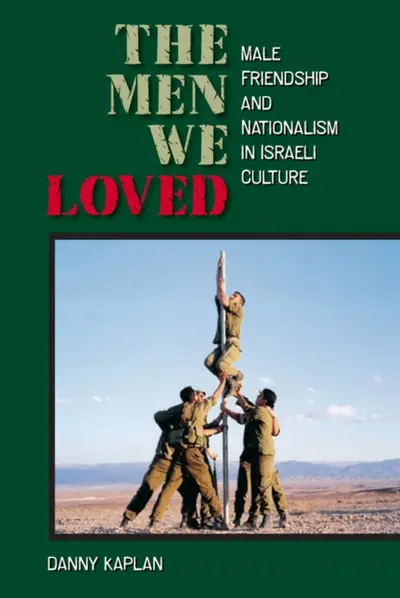
Men We Loved
Male Friendship and Nationalism in Israeli Culture
Price and availability
$21.99
Available in: Andorra, Austria, Australia, Belgium, Bulgaria, Canada, Switzerland, Cyprus, Czechia, Germany, Denmark, Estonia, Spain, Finland, France, United Kingdom, Guernsey, Greece, Croatia, Hungary, Ireland, Isle of Man, Iceland, Italy, Jersey, Japan, Liechtenstein, Lithuania, Luxembourg, Latvia, Monaco, Malta, Netherlands, Norway, Poland, Portugal, Romania, Sweden, Slovenia, Slovakia, San Marino, United States, Vatican City, South Africa
Stores: US, UK, Canada, EU, Australia.
Sign in to buyThe price is re-checked by the server before payment.
For personal use under the eBook licence.
- Format
- DRM
- Not stated by the publisher
- Language
- English
- Publisher
- Berghahn Books
- Published
- 1 November 2006
- ISBN
- 9781782389378
- Subjects
- Gender studies, gender groups, Gender studies: men, Social, group or collective psychology, Nationalism, Land forces & warfare, Gender studies: men and boys, Nationalism and nationalist ideologies and movements
About this book
Some semi-public, exclusive male settings, most noticeably in the military, encourage the production of intimacy and desire. Yet whereas in most instances this desire is displaced through humor and aggressive gestures, it becomes acknowledged and outright declared once associated with sites of heroic death. In his provocative study of interrelations between friendship in everyday life and national sentiments in Israel, the author follows selected stories of friendship ranging over early childhood, school, the workplace, and some unique war experiences. He explores the symbolism of friendship in rituals for the fallen soldiers, the commemoration of Prime Minister Yzhak Rabin, and the national infatuation with recovering bodies of missing soldiers. He concludes that the Israeli case offers an extreme instance of a much broader cultural phenomenon: declaring the friendship for the dead epitomizes the political blood pact between men, taking precedence over the traditional blood ties of kinship and heterosexual unions. The book underscores nationalism as a homosocial-based emotion of commemorative desire.
Bibliographic data © Gardners Books Ltd.