PDF · English
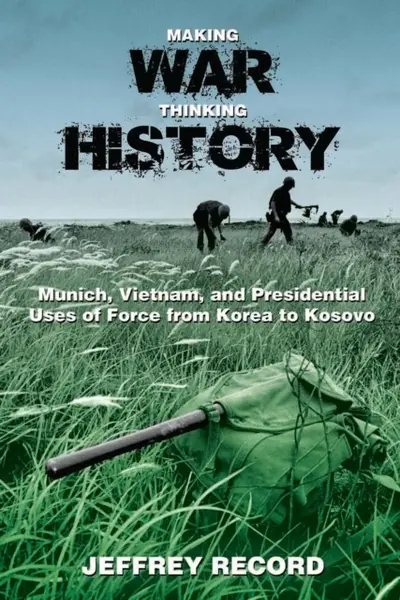
Making War, Thinking History
Munich, Vietnam, and Presidential Uses of Force from Korea to Kosovo
Price and availability
$16.99
Available in: Andorra, Austria, Australia, Belgium, Bulgaria, Canada, Switzerland, Cyprus, Czechia, Germany, Denmark, Estonia, Spain, Finland, France, United Kingdom, Guernsey, Greece, Croatia, Hungary, Ireland, Isle of Man, Iceland, Italy, Jersey, Japan, Liechtenstein, Lithuania, Luxembourg, Latvia, Monaco, Malta, Netherlands, Norway, Poland, Portugal, Romania, Sweden, Slovenia, Slovakia, San Marino, United States, Vatican City, South Africa
Stores: US, UK, Canada, EU, Australia.
Sign in to buyThe price is re-checked by the server before payment.
For personal use under the eBook licence.
- Format
- DRM
- Not stated by the publisher
- Language
- English
- Publisher
- Naval Institute Press
- Published
- 15 February 2014
- ISBN
- 9781612515816
- Subjects
- USA, 20th century, History of the Americas, 20th century history: c 1900 to c 2000, Military history, Political science & theory, Political structure & processes, United States of America, USA, 3MP, Political science and theory, Political structure and processes, NH, NHK, NHW
About this book
In examining the influence of historical analogies on decisions to use--or not use--force, military strategist Jeffrey Record assesses every major application of U.S. force from the Korean War to the NATO war on Serbia. Specifically, he looks at the influence of two analogies: the democracies? appeasement of Hitler at Munich and America's defeat in the Vietnam War. His book judges the utility of these two analogies on presidential decision-making and finds considerable misuse of them in situations where force was optional. He points to the Johnson administration's application of the Munich analogy to the circumstances of Southeast Asia in 1965 as the most egregious example of their misuse, but also cites the faulty reasoning by historical analogy that prevailed among critics of Reagan's policy in Central America and in Clinton's use of force in Haiti and the former Yugoslavia. The author's findings show generational experience to be a key influence on presidential decision-making: Munich persuaded mid-twentieth-century presidents that force should be used early and decisively while Vietnam cautioned later presidents against using force at all. Both analogies were at work for the Gulf War, with Munich urging a decision for war and Vietnam warning against a graduated and highly restricted use of force. Record also reminds us of the times when presidents have used analogies to mobilize public support for action they have already decided to take. Addressing both the process of presidential decision-making and the wisdom of decisions made, this well-reasoned book offers timely lessons to a broad audience that includes political scientists, military historians, defense analysts, and policy makers, as well as those simply curious about history's influence.
Bibliographic data © Gardners Books Ltd.