EPUB · English
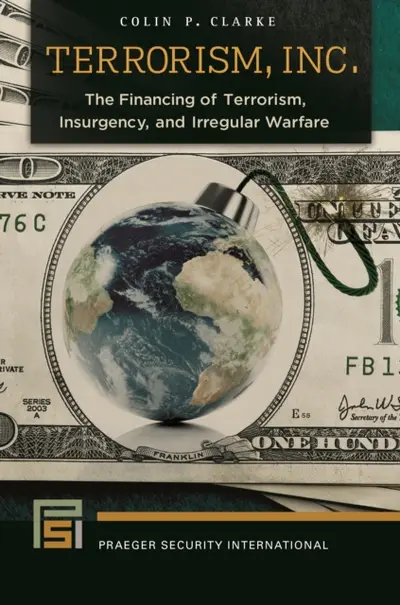
Terrorism, Inc.
The Financing of Terrorism, Insurgency, and Irregular Warfare
Price and availability
$72.99
Available in: Andorra, Austria, Australia, Belgium, Bulgaria, Canada, Switzerland, Cyprus, Czechia, Germany, Denmark, Estonia, Spain, Finland, France, United Kingdom, Guernsey, Greece, Croatia, Hungary, Ireland, Isle of Man, Iceland, Italy, Jersey, Japan, Liechtenstein, Lithuania, Luxembourg, Latvia, Monaco, Malta, Netherlands, Norway, Poland, Portugal, Romania, Sweden, Slovenia, Slovakia, San Marino, United States, Vatican City, South Africa
Stores: US, UK, Canada, EU, Australia.
Sign in to buyThe price is re-checked by the server before payment.
For personal use under the eBook licence.
- Format
- EPUB
- DRM
- Not stated by the publisher
- Language
- English
- Publisher
- Bloomsbury Publishing (USA)
- Published
- 1 June 2015
- Pages
- 304
- ISBN
- 9798216154556
- Subjects
- Politics & government, Terrorism, armed struggle, Politics and government, Terrorism, armed struggle
About this book
This in-depth, historical analysis of terrorism investigates the major funding streams of terrorists, insurgents, guerrillas, warlords, militias, and criminal organizations throughout the world as well as the efforts of the international community to thwart their efforts.Terrorist financing is an ongoing game of creating, concealing, and surreptitiously utilizing funds. This intriguing book considers every facet of guerrilla funding-from how activities are financed, to what insurgents do with the revenue they generate, to the range of countermeasures in place for deterring their moneymaking activities. Case studies prompt an analysis of past government responses and inform recommendations for countering irregular warfare worldwide.Author Colin P. Clarke presents the business side of terrorism, taking a look at the cash-producing ventures he labels "e;gray activities"e; such as diaspora support, charities, fraudulent businesses, front companies, and money laundering as well as "e;dark activities"e; including kidnapping for ransom, robbery, smuggling, trafficking, and extortion. He considers the transnational efforts to stop terrorist activities-from wiretaps and electronic surveillance to financial sanctions and the freezing of funds and accounts-and points to the emergence of interagency task forces for detaining and destroying the operations of major criminal organizations across the globe.
Bibliographic data © Gardners Books Ltd.