PDF · English
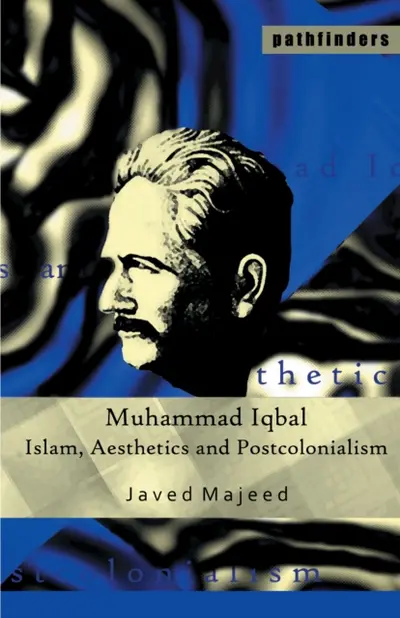
Muhammad Iqbal
Islam, Aesthetics and Postcolonialism
Price and availability
$59.99
Available in: Andorra, Austria, Australia, Belgium, Bulgaria, Canada, Switzerland, Cyprus, Czechia, Germany, Denmark, Estonia, Spain, Finland, France, United Kingdom, Guernsey, Greece, Croatia, Hungary, Ireland, Isle of Man, Iceland, Italy, Jersey, Japan, Liechtenstein, Lithuania, Luxembourg, Latvia, Monaco, Malta, Netherlands, Norway, Poland, Portugal, Romania, Sweden, Slovenia, Slovakia, San Marino, United States, Vatican City, South Africa
Stores: US, UK, Canada, EU, Australia.
Sign in to buyThe price is re-checked by the server before payment.
For personal use under the eBook licence.
- Format
- DRM
- Not stated by the publisher
- Language
- English
- Publisher
- Taylor & Francis
- Published
- 29 November 2020
- ISBN
- 9781000087970
- Subjects
- Asia, Indian sub-continent, Modern Indic languages, Biography: general, Biography: historical, political & military, Biography: literary, Literary studies: c 1800 to c 1900, Literary studies: from c 1900 -, Literary studies: fiction, novelists & prose writers, Asian history, Colonialism & imperialism, National liberation & independence, post-colonialism, Philosophy, Philosophy of religion, Islam, Political science & theory, Political leaders & leadership, South Asia (Indian sub-continent)
About this book
Bringing together Islamic studies, a postcolonial literary perspective, and a focus on the interaction between aesthetics and politics, this book analyses Iqbal's Islamism through his poetry. It argues that his notion of an Islamist selfhood was expressed in his verse through the interplay between poetic tradition and creative innovation. It also considers how Iqbal expressed an Islamist geopolitical imagination in his work, and examines his exploration of the relationship between the modern West and a reconstructed Islam. For the first time, Iqbal's personal letters have been drawn upon to provide an insight into his inner conflicts as articulated in his poetry. Concentrating on the complexity of his work in its own right, the book eschews the standard appropriation of Iqbal into any one political agenda - be it Indian nationalism, Muslim separatism or Iranian Islamic republicanism. With its analytical and in-depth reading of Iqbal's verse and prose, this book opens a fresh perspective on Islam and postcolonialism. It will be a fascinating study for general readers and readers with interests in the intellectual and political history of modern South Asia, colonialism and postcolonialism, Islamic studies, and modern South Asian literature (especially Urdu and Persian poetry).
Bibliographic data © Gardners Books Ltd.