PDF · English
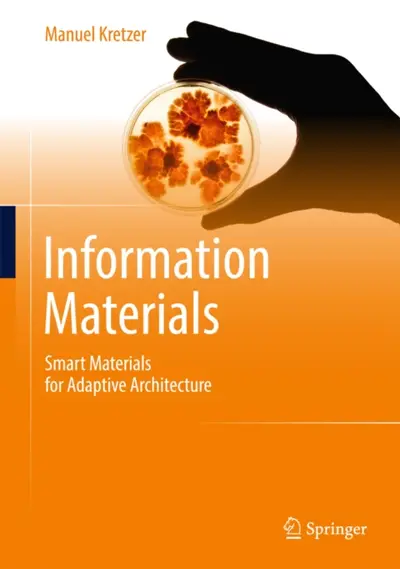
Information Materials
Smart Materials for Adaptive Architecture
Price and availability
$134.99
Available in: Andorra, Austria, Australia, Belgium, Bulgaria, Canada, Switzerland, Cyprus, Czechia, Germany, Denmark, Estonia, Spain, Finland, France, United Kingdom, Guernsey, Greece, Croatia, Hungary, Ireland, Isle of Man, Iceland, Italy, Jersey, Japan, Liechtenstein, Lithuania, Luxembourg, Latvia, Monaco, Malta, Netherlands, Norway, Poland, Portugal, Romania, Sweden, Slovenia, Slovakia, San Marino, United States, Vatican City, South Africa
Stores: US, UK, Canada, EU, Australia.
Sign in to buyThe price is re-checked by the server before payment.
For personal use under the eBook licence.
- Format
- DRM
- Not stated by the publisher
- Language
- English
- Publisher
- Springer International Publishing
- Published
- 3 November 2016
- ISBN
- 9783319351506
- Subjects
- Architectural structure & design, Building construction & materials, Architecture, Higher education, tertiary education, Technology: general issues, Materials science, Building construction and materials
About this book
This book considers the potential of new, smart materials and their use in architecture. It begins with an overview of current global tendencies (technological, demographic, and socio-anthropological) and their relevance for architectural design. Expanding upon approaches for flexible design solutions to address change and uncertainty, Dr. Kretzer begins by exploring adaptive architecture and proceeds to introduce the topic of "e;information materials,"e; which encompasses smart and functional materials, their current usage, and their potential for the creation of future spaces. The second chapter provides a comprehensive overview of architectural materials, past and present, split into the topics: natural, industrial, synthetic, digital, and information materials. Chapter three introduces an educational approach for the mediation of information material usage in design courses and student workshops. The final section provides detailed information on a range of emerging material phenomena, including aerogels, bioluminescence, bio plastics, dye-sensitized solar cells, electroluminescent displays, electroactive polymers, soft robotics, and thermochromics. Each section explains its respective history, working principles, fabrication and (potential) usage in architecture and design, and provides hands-on tutorials on how to self-produce these materials, and displays class-tested experimental installations. The book concludes with an outlook into the domain of synthetic biology and the prospects of a "e;living"e; architecture. It is ideal for students of structural materials engineering, architecture, and urban planning; professionals working these in areas, as well as materials science/engineering and architecture educators.
Bibliographic data © Gardners Books Ltd.