EPUB · English
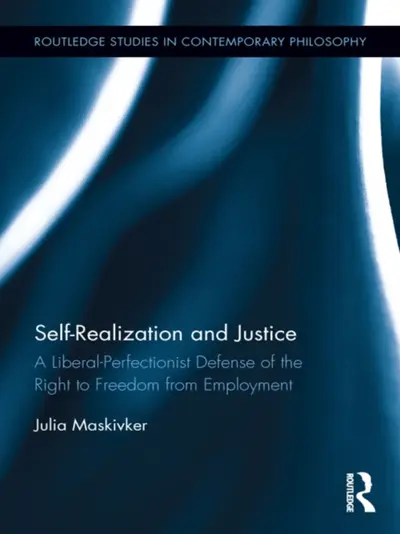
Self-Realization and Justice
A Liberal-Perfectionist Defense of the Right to Freedom from Employment
Price and availability
$74.99
Available in: Andorra, Austria, Australia, Belgium, Bulgaria, Canada, Switzerland, Cyprus, Czechia, Germany, Denmark, Estonia, Spain, Finland, France, United Kingdom, Guernsey, Greece, Croatia, Hungary, Ireland, Isle of Man, Iceland, Italy, Jersey, Japan, Liechtenstein, Lithuania, Luxembourg, Latvia, Monaco, Malta, Netherlands, Norway, Poland, Portugal, Romania, Sweden, Slovenia, Slovakia, San Marino, United States, Vatican City, South Africa
Stores: US, UK, Canada, EU, Australia.
Sign in to buyThe price is re-checked by the server before payment.
For personal use under the eBook licence.
- Format
- EPUB
- DRM
- Not stated by the publisher
- Language
- English
- Publisher
- Taylor & Francis
- Published
- 1 March 2013
- ISBN
- 9781136463907
- Subjects
- Philosophy, Social & political philosophy, Social theory, Political science & theory, Liberalism & centre democratic ideologies, Industrial relations, Political science and theory, Public administration / Public policy, Ethics and moral philosophy
About this book
In this book, Maskivker argues that there ought to be a right not to participate in the paid economy in a new way; not by appealing to notions of fairness to competing conceptions of the good, but rather to a contentious (but defensible) normative ideal, namely, self-realization. In so doing, she joins a venerable tradition in ethical thought, initiated by Aristotle and developed in the work of important eighteenth and nineteenth century thinkers including Smith, Hume, and Marx.The book engages on-going debates (in both philosophical and real world political and social policy circles) about the provision of basic income grants, necessary to make the possibility of self-realization real for all. Traditional defenses of unconditional welfare benefits emphasize ideals of state neutrality when they claim that society should not discriminate against preferences for leisure in favor of preferences for work. According to these views, the state ought not to interfere with people's choices about what constitutes the "e;good life."e; In contradistinction, Maskivker offers an innovative argument in defense of a particular ideal of the "e;good life,"e; namely, life-goals directed at the pursuit of self-realization. However, her understanding of self-realization appeals to modern and contemporary values of freedom and pluralism. In a refreshingly new light, the book strikes a balance between fascinating debates on the conditions of human flourishing on the one hand, and heated discussions about the Welfare State on the other.
Bibliographic data © Gardners Books Ltd.