PDF · English
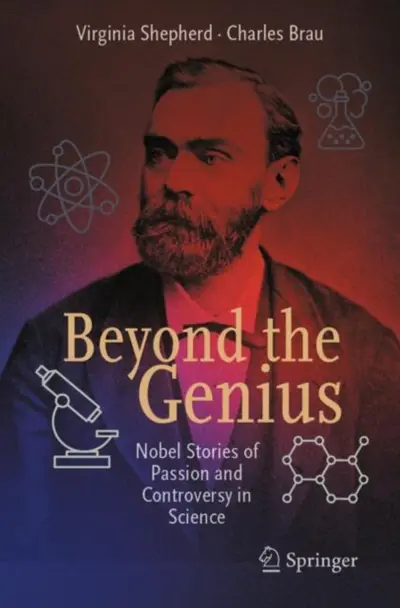
Beyond the Genius
Nobel Stories of Passion and Controversy in Science
Price and availability
$29.99
Available in: Andorra, Austria, Australia, Belgium, Bulgaria, Canada, Switzerland, Cyprus, Czechia, Germany, Denmark, Estonia, Spain, Finland, France, United Kingdom, Guernsey, Greece, Croatia, Hungary, Ireland, Isle of Man, Iceland, Italy, Jersey, Japan, Liechtenstein, Lithuania, Luxembourg, Latvia, Monaco, Malta, Netherlands, Norway, Poland, Portugal, Romania, Sweden, Slovenia, Slovakia, San Marino, United States, Vatican City, South Africa
Stores: US, UK, Canada, EU, Australia.
Sign in to buyThe price is re-checked by the server before payment.
For personal use under the eBook licence.
- Format
- DRM
- Not stated by the publisher
- Language
- English
- Publisher
- Springer Nature Switzerland
- Published
- 30 December 2025
- ISBN
- 9783032027351
- Subjects
- Ethics & moral philosophy, Medical research, Philosophy of science, History of science, Physics, Chemistry, History of engineering & technology, Medical research, Philosophy of science, History of science, Physics, Chemistry, Ethics and moral philosophy, History of engineering and technology
About this book
Using the fascinating stories surrounding the lives and struggles of eight Nobel Laureate scientists, this book illustrates the complexity of scientific discovery. Factors such as their passion for science, gender, Jewish roots, nationalism, self-promotion, and just plain hubris all shaped their careers and their discoveries, while competition and politics influenced the Nobel Prizes that they were awarded or denied. For example, the discovery of fission by Hahn and Meitner depended on perseverance, taking months of tedious work to prove that the accepted theories were wrong, while the discovery of the transistor by Bardeen and Brattain was serendipitous. The lives of the Nobel Laureates also illustrate the importance of ethics in science. Fritz Haber’s fixation of nitrogen to make fertilizer now feeds half the world’s population, but he also introduced poisonous gas into World War I, and after sharing the Nobel Prize for the transistor, William Shockley went into racist eugenics. Several of the lives described in the book, show how Nobel Prize discoveries have had varying impacts on the world, from the fixation of nitrogen and its huge influence on global supply and the transistor’s birthing of the digital age, to a disease found deep in the jungles of Papua New Guinea and prion research. Finally, the book tells the story of Alfred Nobel himself, and the founding of the Nobel Prizes. How the Prizes have been awarded – or denied – and how they have affected the lives and of scientists and their discoveries make an engaging story. Each scientific discovery discussed in the text is explained in elementary terms, making this book essential reading for anyone interested in science as a human endeavor or the complex relationship between science and society.
Bibliographic data © Gardners Books Ltd.