PDF · English
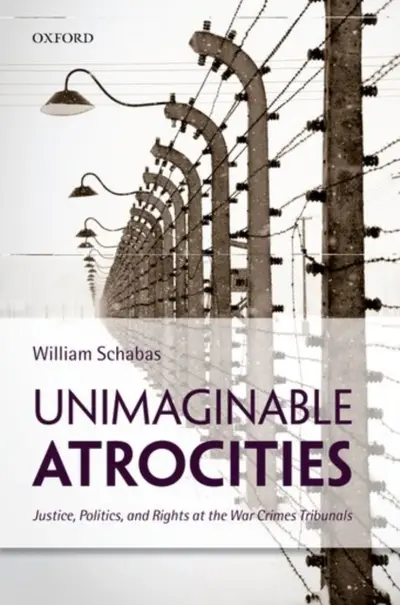
Unimaginable Atrocities
Justice, Politics, and Rights at the War Crimes Tribunals
Price and availability
$44.99
Available in: Andorra, Austria, Australia, Belgium, Bulgaria, Canada, Switzerland, Cyprus, Czechia, Germany, Denmark, Estonia, Spain, Finland, France, United Kingdom, Guernsey, Greece, Croatia, Hungary, Ireland, Isle of Man, Iceland, Italy, Jersey, Japan, Liechtenstein, Lithuania, Luxembourg, Latvia, Monaco, Malta, Netherlands, Norway, Poland, Portugal, Romania, Sweden, Slovenia, Slovakia, San Marino, United States, Vatican City, South Africa
Stores: US, UK, Canada, EU, Australia.
Sign in to buyThe price is re-checked by the server before payment.
For personal use under the eBook licence.
- Format
- DRM
- Not stated by the publisher
- Language
- English
- Publisher
- Oxford University Press
- Published
- 23 February 2012
- ISBN
- 9780191612213
- Subjects
- Genocide & ethnic cleansing, International relations, War crimes, International criminal law, International courts & procedures, International relations, War crimes, Public international law: criminal law, International law: courts and procedures, Genocide and ethnic cleansing
About this book
As international criminal courts and tribunals have proliferated and international criminal law is increasingly seen as a key tool for bringing the world's worst perpetrators to account, the controversies surrounding the international trials of war criminals have grown. War crimes tribunals have to deal with accusations of victor's justice, bad prosecutorial policy and case management, and of jeopardizing fragile peace in post-conflict situations. In this exceptional book, one of the leading writers in the field of international criminal law explores these controversial issues in a manner that is accessible both to lawyers and to general readers. Professor William Schabas begins by considering the discipline of international criminal law, outlining the differing approaches to the description of international crimes and examining the frequent claims relating to the retroactive application of these crimes. The book then discusses the relationship between genocide and crimes against humanity, studying the fascination with what Schabas calls the 'genocide mystique'. International criminal tribunals have often been stigmatized as an exercise in victor's justice. This book traces how this critique developed and the difficulty it poses to the identification of situations for prosecution by the International Criminal Court. The claim that amnesty for international crimes is prohibited by international law is challenged, with a more nuanced approach to the relationship between justice and peace being proposed. Throughout the book there is a strong historical perspective, with constant reference to the early experiments in international justice at Nuremberg and Tokyo. The work also analyses the growing pains of the International Criminal Court as it enters its second decade.
Bibliographic data © Gardners Books Ltd.