PDF · English
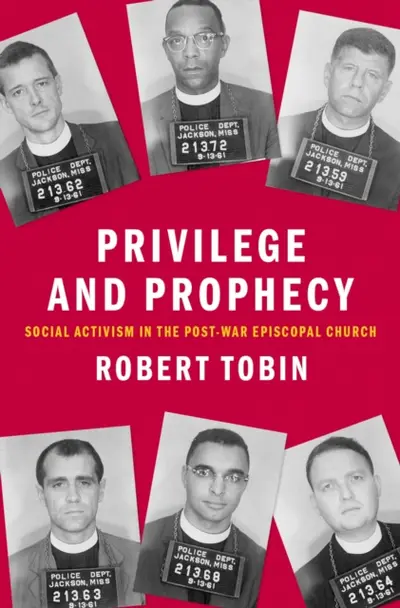
Privilege and Prophecy
Social Activism in the Post-War Episcopal Church
Price and availability
$25.99
Available in: Andorra, Austria, Australia, Belgium, Bulgaria, Canada, Switzerland, Cyprus, Czechia, Germany, Denmark, Estonia, Spain, Finland, France, United Kingdom, Guernsey, Greece, Croatia, Hungary, Ireland, Isle of Man, Iceland, Italy, Jersey, Japan, Liechtenstein, Lithuania, Luxembourg, Latvia, Monaco, Malta, Netherlands, Norway, Poland, Portugal, Romania, Sweden, Slovenia, Slovakia, San Marino, United States, Vatican City, South Africa
Stores: US, UK, Canada, EU, Australia.
Sign in to buyThe price is re-checked by the server before payment.
For personal use under the eBook licence.
- Format
- DRM
- Not stated by the publisher
- Language
- English
- Publisher
- Oxford University Press
- Published
- 1 March 2022
- ISBN
- 9780190906153
- Subjects
- History of the Americas, Religion & politics, Protestantism & Protestant Churches, Christian life & practice, NHK, QRAM2, QRMB3, QRMP
About this book
The Episcopal Church has long been regarded as the religion of choice among America's ruling elite, helping to set the tone for the moral and social life of the nation during the twentieth century. Shaped by their experiences of the Great Depression and World War II, a new generation of Episcopal leaders emerged after 1945, eager to place their church in the vanguard of social reform and reconciliation. These liberal activists came to dominate the church's national structures during the 1960s and shaped its response to the civil rights and anti-war movements. They sought to reposition the Episcopal Church as a catalyst for progressive change. Even so, these leaders routinely neglected black, female, and working-class Episcopalians, even as they espoused the causes of equality and liberation in the wider society. This study focuses on forms of social activism and theological innovation pursued by members of the war generation. Attending to the development of such activities among the WASP elite provides crucial insight into their underlying assumptions about social and theological authority and helps explain their ambivalent response to the challenges faced in the 1960s and 1970s. Drawing upon extensive archival research, this book not only offers a group portrait of Episcopalianism's leading post-war figures but documents the ways in which their individual pursuits influenced the direction of the church as a whole.
Bibliographic data © Gardners Books Ltd.