EPUB · English
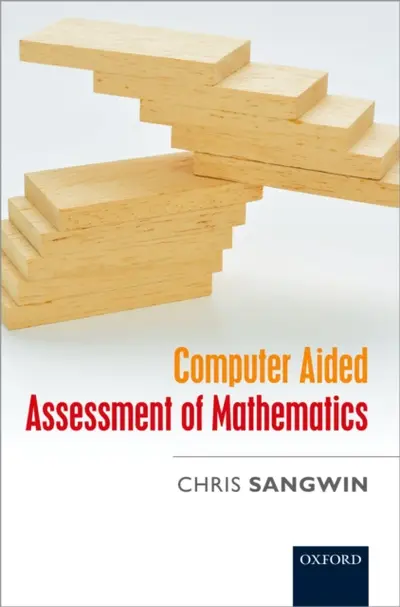
Computer Aided Assessment of Mathematics
Price and availability
$68.99
Available in: Andorra, Austria, Australia, Belgium, Bulgaria, Canada, Switzerland, Cyprus, Czechia, Germany, Denmark, Estonia, Spain, Finland, France, United Kingdom, Guernsey, Greece, Croatia, Hungary, Ireland, Isle of Man, Iceland, Italy, Jersey, Japan, Liechtenstein, Lithuania, Luxembourg, Latvia, Monaco, Malta, Netherlands, Norway, Poland, Portugal, Romania, Sweden, Slovenia, Slovakia, San Marino, United States, Vatican City, South Africa
Stores: US, UK, Canada, EU, Australia.
Sign in to buyThe price is re-checked by the server before payment.
For personal use under the eBook licence.
- Format
- EPUB
- DRM
- Not stated by the publisher
- Language
- English
- Publisher
- Oxford University Press
- Published
- 2 May 2013
- ISBN
- 9780191635861
- Subjects
- Teaching skills & techniques, Teaching of a specific subject, Mathematics, Educational: Mathematics & numeracy, Teaching skills and techniques, Mathematics, Educational: Mathematics and numeracy
About this book
Assessment is a key driver in mathematics education. This book examines computer aided assessment (CAA) of mathematics in which computer algebra systems (CAS) are used to establish the mathematical properties of expressions provided by students in response to questions. In order to automate such assessment, the relevant criteria must be encoded and, in articulating precisely the desired criteria, the teacher needs to think very carefully about the goals of the task. Hence CAA acts as a vehicle to examine assessment and mathematics education in detail and from a fresh perspective. One example is how it is natural for busy teachers to set only those questions that can be marked by hand in a straightforward way, even though the constraints of paper-based formats restrict what they do and why. There are other kinds of questions, such as those with non-unique correct answers, or where assessing the properties requires the marker themselves to undertake a significant computation. It is simply not sensible for a person to set these to large groups of students when marking by hand. However, such questions have their place and value in provoking thought and learning. This book, aimed at teachers in both schools and universities, explores how, in certain cases, different question types can be automatically assessed. Case studies of existing systems have been included to illustrate this in a concrete and practical way.
Bibliographic data © Gardners Books Ltd.