PDF · English
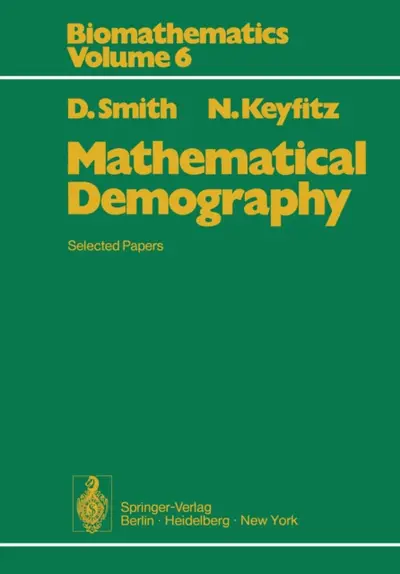
Mathematical Demography
Selected Papers
Price and availability
$97.99
Available in: Andorra, Austria, Australia, Belgium, Bulgaria, Canada, Switzerland, Cyprus, Czechia, Germany, Denmark, Estonia, Spain, Finland, France, United Kingdom, Guernsey, Greece, Croatia, Hungary, Ireland, Isle of Man, Iceland, Italy, Jersey, Japan, Liechtenstein, Lithuania, Luxembourg, Latvia, Monaco, Malta, Netherlands, Norway, Poland, Portugal, Romania, Sweden, Slovenia, Slovakia, San Marino, United States, Vatican City, South Africa
Stores: US, UK, Canada, EU, Australia.
Sign in to buyThe price is re-checked by the server before payment.
For personal use under the eBook licence.
- Format
- DRM
- Not stated by the publisher
- Language
- English
- Publisher
- Springer Berlin Heidelberg
- Published
- 6 December 2012
- ISBN
- 9783642810466
- Subjects
- Applied mathematics, Applied mathematics
About this book
This volume is an effort to bring together important contributions to the mathe- matical development of demography and to suggest briefly their historical context. We have tried to find who first thought of the several concepts and devices commonly used by demographers, what sort of problem he was facing to which the device or concept seemed the solution, and how his invention developed subsequently in the hands of others. Historically, the book starts with a Roman table of life expectancies from the third century a. d. about which we know little, and with John Graunt's explora- tions in an area that was still popularly suspect when he wrote in 1662. These are followed by the astronomer Halley, who looked into the field long enough to invent the life table and to notice that Their Majesties would take a sizeable loss on the annuity scheme they had just launched; and by Euler, who was first to devise the formulas of stable population theory and to apply them to filling gaps in data To these we add the handful of further contributions in the 19th century and many pieces from the explosion of contributions that began in this century with Lotka. We doubt that we have managed to trace everything back to its ultimate beginning, and suspect that our nominees in some cases have been anticipated by predecessors who will be turned up by other students.
Bibliographic data © Gardners Books Ltd.