PDF · English
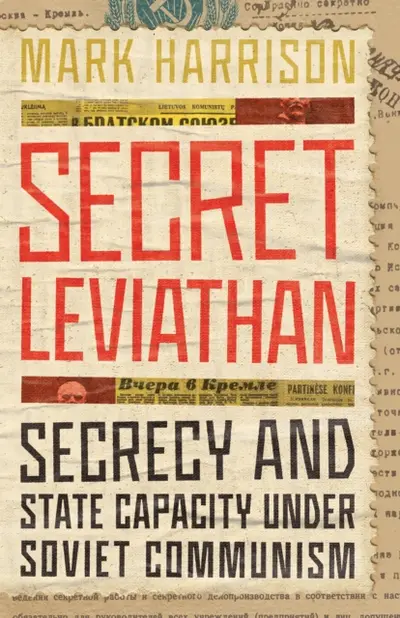
Secret Leviathan
Secrecy and State Capacity under Soviet Communism
Price and availability
$66.99
Available in: Andorra, Austria, Australia, Belgium, Bulgaria, Canada, Switzerland, Cyprus, Czechia, Germany, Denmark, Estonia, Spain, Finland, France, United Kingdom, Guernsey, Greece, Croatia, Hungary, Ireland, Isle of Man, Iceland, Italy, Jersey, Japan, Liechtenstein, Lithuania, Luxembourg, Latvia, Monaco, Malta, Netherlands, Norway, Poland, Portugal, Romania, Sweden, Slovenia, Slovakia, San Marino, United States, Vatican City, South Africa
Stores: US, UK, Canada, EU, Australia.
Sign in to buyThe price is re-checked by the server before payment.
For personal use under the eBook licence.
- Format
- DRM
- Not stated by the publisher
- Language
- English
- Publisher
- Stanford University Press
- Published
- 6 June 2023
- ISBN
- 9781503635845
- Subjects
- Former Soviet Union, USSR (Europe), Russia, 20th century, General & world history, European history, 20th century history: c 1900 to c 2000, Political ideologies, Marxism & Communism, 3MP, Political ideologies and movements, Far-left political ideologies and movements, NH, NHB, NHD
About this book
The Soviet Union was one of the most secretive states that ever existed. Defended by a complex apparatus of rules and checks administered by the secret police, the Soviet state had seemingly unprecedented capabilities based on its near monopoly of productive capital, monolithic authority, and secretive decision making. But behind the scenes, Soviet secrecy was double-edged: it raised transaction costs, incentivized indecision, compromised the effectiveness of government officials, eroded citizens' trust in institutions and in each other, and led to a secretive society and an uninformed elite. The result is what this book calls the secrecy/capacity tradeoff: a bargain in which the Soviet state accepted the reduction of state capacity as the cost of ensuring its own survival.This book is the first comprehensive, analytical, multi-faceted history of Soviet secrecy in the English language. Harrison combines quantitative and qualitative evidence to evaluate the impact of secrecy on Soviet state capacity from the 1917 Bolshevik Revolution to the collapse of the Soviet Union in 1991. Based on multiple years of research in once-secret Soviet-era archives, this book addresses two gaps in history and social science: one the core role of secrecy in building and stabilizing the communist states of the twentieth century; the other the corrosive effects of secrecy on the capabilities of authoritarian states.
Bibliographic data © Gardners Books Ltd.