PDF · English
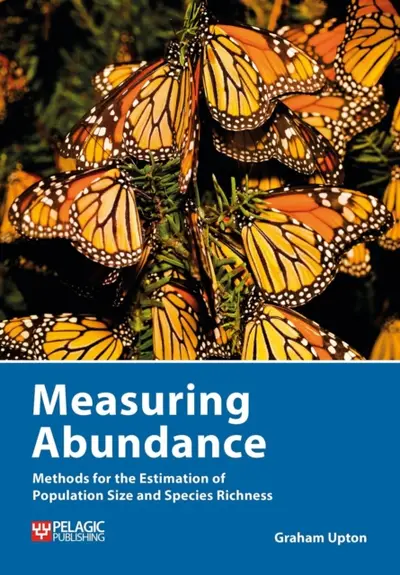
Measuring Abundance
Methods for the Estimation of Population Size and Species Richness
Price and availability
$108.99
Available in: Andorra, Austria, Australia, Belgium, Bulgaria, Canada, Switzerland, Cyprus, Czechia, Germany, Denmark, Estonia, Spain, Finland, France, United Kingdom, Guernsey, Greece, Croatia, Hungary, Ireland, Isle of Man, Iceland, Italy, Jersey, Japan, Liechtenstein, Lithuania, Luxembourg, Latvia, Monaco, Malta, Netherlands, Norway, Poland, Portugal, Romania, Sweden, Slovenia, Slovakia, San Marino, United States, Vatican City, South Africa
Stores: US, UK, Canada, EU, Australia.
Sign in to buyThe price is re-checked by the server before payment.
For personal use under the eBook licence.
- Format
- DRM
- Not stated by the publisher
- Language
- English
- Publisher
- Pelagic Publishing
- Published
- 12 October 2020
- ISBN
- 9781784272340
- Subjects
- Probability & statistics, Ecological science, the Biosphere, Animal ecology, Excel, Data capture & analysis, Data science and analysis, Probability and statistics, Ecological science, the Biosphere, Zoology and animal sciences, Data capture and analysis
About this book
Measuring the abundance of individuals and the diversity of species are core components of most ecological research projects and conservation monitoring. This book brings together in one place, for the first time, the methods used to estimate the abundance of individuals in nature.The statistical basis of each method is detailed along with practical considerations for survey design and data collection. Methods are illustrated using data ranging from Alaskan shrubs to Yellowstone grizzly bears, not forgetting Costa Rican ants and Prince Edward Island lobsters. Where necessary, example code for use with the open source software R is supplied. When appropriate, reference is made to other widely used programs.After opening with a brief synopsis of relevant statistical methods, the first section deals with the abundance of stationary items such as trees, shrubs, coral, etc. Following a discussion of the use of quadrats and transects in the contexts of forestry sampling and the assessment of plant cover, there are chapters addressing line-intercept sampling, the use of nearest-neighbour distances, and variable sized plots.The second section deals with individuals that move, such as birds, mammals, reptiles, fish, etc. Approaches discussed include double-observer sampling, removal sampling, capture-recapture methods and distance sampling.The final section deals with the measurement of species richness; species diversity; species-abundance distributions; and other aspects of diversity such as evenness, similarity, turnover and rarity.This is an essential reference for anyone involved in advanced undergraduate or postgraduate ecological research and teaching, or those planning and carrying out data analysis as part of conservation survey and monitoring programmes.
Bibliographic data © Gardners Books Ltd.