PDF · English
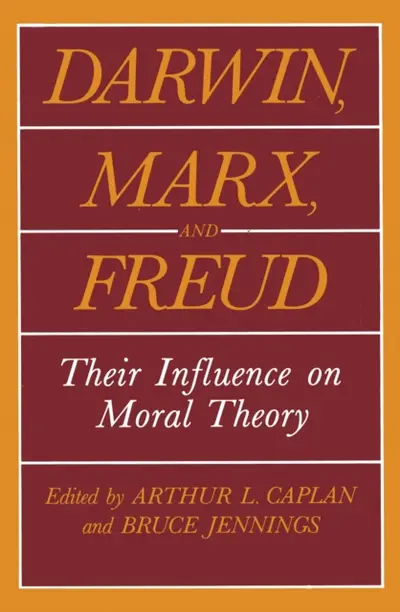
Darwin, Marx and Freud
Their Influence on Moral Theory
- Society & social sciences
- Politics & law
- Economics, business & finance
- Science & mathematics
- Medicine & health
- Philosophy & religion
Price and availability
$120.99
Available in: Andorra, Austria, Australia, Belgium, Bulgaria, Canada, Switzerland, Cyprus, Czechia, Germany, Denmark, Estonia, Spain, Finland, France, United Kingdom, Guernsey, Greece, Croatia, Hungary, Ireland, Isle of Man, Iceland, Italy, Jersey, Japan, Liechtenstein, Lithuania, Luxembourg, Latvia, Monaco, Malta, Netherlands, Norway, Poland, Portugal, Romania, Sweden, Slovenia, Slovakia, San Marino, United States, Vatican City, South Africa
Stores: US, UK, Canada, EU, Australia.
Sign in to buyThe price is re-checked by the server before payment.
For personal use under the eBook licence.
- Format
- DRM
- Not stated by the publisher
- Language
- English
- Publisher
- Springer US
- Published
- 8 March 2013
- ISBN
- 9781468478501
- Subjects
- Ethics & moral philosophy, Society & culture: general, Sociology, Politics & government, Political science & theory, Business & management, Management & management techniques, Clinical psychology, Evolution, Society and Social Sciences, Sociology, Political science and theory, Business and Management, Clinical psychology, Evolution / Evolutionary biology, Ethics and moral philosophy
About this book
hope of obtaining a comprehensive and coherent understand- ing of the human condition, we must somehow weave together the biological, sociological, and psychological components of human nature and experience. And this cannot be done- indeed, it is difficult to even make sense of an attempt to do it-without first settling our accounts with Darwin, Marx, and Freud. The legacy of these three thinkers continues to haunt us in other ways as well. Whatever their substantive philosophical differences in other respects, Darwin, Marx, and Freud shared a common, overriding intellectual orientation: they taught us to see human things in historical, developmental terms. Phil- osophically, questions of being were displaced in their works by questions of becoming. Methodologically, genesis replaced teleological and essentialist considerations in the explanatory logic of their theories. Darwin, Marx, and Freud were, above all, theorists of conflict, dynamism, and change. They em- phasized the fragility of order, and their abiding concern was always to discover and to explicate the myriad ways in which order grows out of disorder. For these reasons their theories constantly confront and challenge the cardinal tenet of our modern secular faith: the notion of progress. To be sure, their emphasis on conflict and the flux of change within the flow of time was not unprecedented; its origins in Western thought can be traced back at least as far as Heraclitus.
Bibliographic data © Gardners Books Ltd.