PDF · English
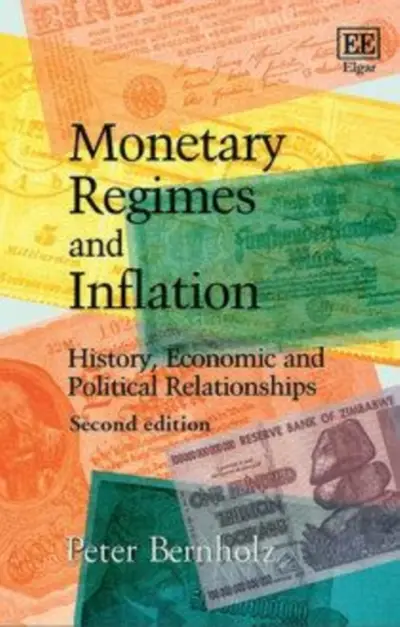
Monetary Regimes and Inflation
History, Economic and Political Relationships, Second Edition
Price and availability
$33.99
Available in: Andorra, Austria, Australia, Belgium, Bulgaria, Canada, Switzerland, Cyprus, Czechia, Germany, Denmark, Estonia, Spain, Finland, France, United Kingdom, Guernsey, Greece, Croatia, Hungary, Ireland, Isle of Man, Iceland, Italy, Jersey, Japan, Liechtenstein, Lithuania, Luxembourg, Latvia, Monaco, Malta, Netherlands, Norway, Poland, Portugal, Romania, Sweden, Slovenia, Slovakia, San Marino, United States, Vatican City, South Africa
Stores: US, UK, Canada, EU, Australia.
Sign in to buyThe price is re-checked by the server before payment.
For personal use under the eBook licence.
- Format
- DRM
- Not stated by the publisher
- Language
- English
- Publisher
- Edward Elgar Publishing
- Published
- 24 April 2015
- ISBN
- 9781784717636
- Subjects
- Monetary economics, Economic history, Finance, Banking, Monetary economics, Economic history, Finance and the finance industry, Banking
About this book
Exploring the characteristics of inflations and comparing historical cases from Roman times up to the modern day, this book provides an in depth discussion of the subject. It analyses the high and moderate inflations caused by the inflationary bias of political systems and economic relationships, as well as the importance of different monetary regimes in containing them. The differences for the possible size of inflations among monetary regimes like metallic currencies, the gold standard and fiat paper money are discussed. It is shown that huge budget deficits of government have been responsible for all hyperinflations. This revised second edition debates whether a growth of the money supply exceeding that of real Gross Domestic Production is a necessary or sufficient reason for inflation and also includes a new concluding chapter, which explores the long-term tendencies to create, maintain and abolish inflation-stable monetary regimes. Moreover, the conditions for long-term inflation-stable monetary regimes in history are explored.By surveying thirty hyperinflations, Peter Bernholz demonstrates that certain economic traits have been stable characteristics of inflations over the centuries, and illustrates their causes. He also examines the consequences of high inflations for unemployment, the distortions between relative prices and the political conditions that allow a return to stable monetary regimes after high inflations, given the inflationary tendencies of political systems.This book will appeal to a wide-ranging audience, including students, economists, historians, political scientists and sociologists looking to improve their knowledge of monetary regimes and inflation. Bankers, businessmen and politicians attempting to solve the problems caused for them by inflation, will also find this to be a useful read.
Bibliographic data © Gardners Books Ltd.