EPUB · English
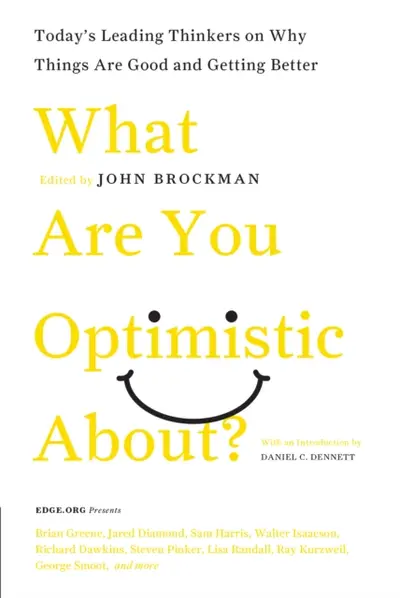
What Are You Optimistic About?
Today''s Leading Thinkers on Why Things Are Good and Getting Better
Price and availability
$12.99
Available in: Andorra, Austria, Australia, Belgium, Bulgaria, Canada, Switzerland, Cyprus, Czechia, Germany, Denmark, Estonia, Spain, Finland, France, United Kingdom, Guernsey, Greece, Croatia, Hungary, Ireland, Isle of Man, Iceland, Italy, Jersey, Japan, Liechtenstein, Lithuania, Luxembourg, Latvia, Monaco, Malta, Netherlands, Norway, Poland, Portugal, Romania, Sweden, Slovenia, Slovakia, San Marino, United States, Vatican City, South Africa
Stores: US, UK, Canada, EU, Australia.
Sign in to buyThe price is re-checked by the server before payment.
For personal use under the eBook licence.
- Format
- EPUB
- DRM
- Not stated by the publisher
- Language
- English
- Publisher
- HarperCollins
- Published
- 13 October 2009
- Pages
- 400
- ISBN
- 9780061870033
- Subjects
- Science: general issues, Popular culture, Science: general issues, Philosophy of science, Impact of science and technology on society, Graphic novel / Comic book / Manga: Memoirs, true stories and non-fiction
About this book
The nightly news and conventional wisdom tell us that things are bad and getting worse. Yet despite dire predictions, scientists see many good things on the horizon. John Brockman, publisher of Edge (www.edge.org), the influential online salon, recently asked more than 150 high-powered scientific thinkers to answer a vital question for our frequently pessimistic times: "e;What are you optimistic about?"e;Spanning a wide range of topicsfrom string theory to education, from population growth to medicine, and even from global warming to the end of worldWhat Are You Optimistic About? is an impressive array of what world-class minds (including Nobel Laureates, Pulitzer Prize winners, New York Times bestselling authors, and Harvard professors, among others) have weighed in to offer carefully considered optimistic visions of tomorrow. Their provocative and controversial ideas may rouse skepticism, but they might possibly change our perceptions of humanity's future.
Bibliographic data © Gardners Books Ltd.