EPUB · English
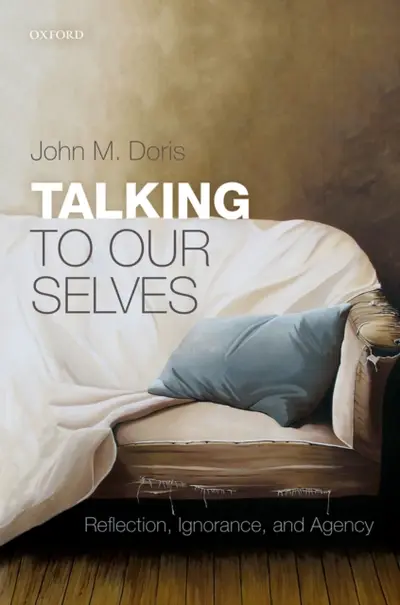
Talking to Our Selves
Reflection, Ignorance, and Agency
Price and availability
$31.99
Available in: Andorra, Austria, Australia, Belgium, Bulgaria, Canada, Switzerland, Cyprus, Czechia, Germany, Denmark, Estonia, Spain, Finland, France, United Kingdom, Guernsey, Greece, Croatia, Hungary, Ireland, Isle of Man, Iceland, Italy, Jersey, Japan, Liechtenstein, Lithuania, Luxembourg, Latvia, Monaco, Malta, Netherlands, Norway, Poland, Portugal, Romania, Sweden, Slovenia, Slovakia, San Marino, United States, Vatican City, South Africa
Stores: US, UK, Canada, EU, Australia.
Sign in to buyThe price is re-checked by the server before payment.
For personal use under the eBook licence.
- Format
- EPUB
- DRM
- Not stated by the publisher
- Language
- English
- Publisher
- Oxford University Press
- Published
- 19 March 2015
- ISBN
- 9780191047329
- Subjects
- Philosophy: epistemology & theory of knowledge, Philosophy of mind, Ethics & moral philosophy, Psychology, Psychological theory & schools of thought, The self, ego, identity, personality, Psychology, Philosophy: epistemology and theory of knowledge, Philosophy of mind
About this book
John M. Doris presents a new account of agency and responsibility, which reconciles our understanding of ourselves as moral agents with psychological research on the unconscious mind. Much philosophical theorizing maintains that the exercise of morally responsible agency consists in judgment and behavior ordered by accurate reflection. On such theories, when human beings are able to direct their lives in the manner philosophers have dignified with the honorific 'agency', it's because they know what they're doing, and why they're doing it. This understanding is compromised by quantities of psychological research on unconscious processing, which suggests that accurate reflection is distressingly uncommon; very often behavior is ordered by surprisingly inaccurate self-awareness. Thus, if agency requires accurate reflection, people seldom exercise agency, and skepticism about agency threatens. To counter the skeptical threat, John M. Doris proposes an alternative theory that requires neither reflection nor accurate self-awareness: he identifies a dialogic form of agency where self-direction is facilitated by exchange of the rationalizations with which people explain and justify themselves to one another. The result is a stoutly interdisciplinary theory sensitive to both what human beings are like-creatures with opaque and unruly psychologies-and what they need: an account of agency sufficient to support a practice of moral responsibility.
Bibliographic data © Gardners Books Ltd.