EPUB · English
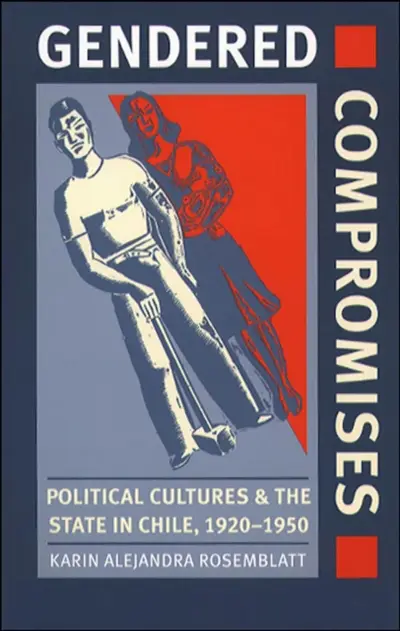
Gendered Compromises
Political Cultures and the State in Chile, 1920-1950
Price and availability
$40.99
Available in: Andorra, Austria, Australia, Belgium, Bulgaria, Canada, Switzerland, Cyprus, Czechia, Germany, Denmark, Estonia, Spain, Finland, France, United Kingdom, Guernsey, Greece, Croatia, Hungary, Ireland, Isle of Man, Iceland, Italy, Jersey, Japan, Liechtenstein, Lithuania, Luxembourg, Latvia, Monaco, Malta, Netherlands, Norway, Poland, Portugal, Romania, Sweden, Slovenia, Slovakia, San Marino, United States, Vatican City, South Africa
Stores: US, UK, Canada, EU, Australia.
Sign in to buyThe price is re-checked by the server before payment.
For personal use under the eBook licence.
- Format
- EPUB
- DRM
- Not stated by the publisher
- Language
- English
- Publisher
- The University of North Carolina Press
- Published
- 19 June 2003
- ISBN
- 9780807860953
- Subjects
- South America, Chile, c 1918 to c 1939 (Inter-war period), c 1939 to c 1945 (including WW2), c 1945 to c 1960, History of the Americas, 20th century history: c 1900 to c 2000, Gender studies, gender groups, Politics & government, South America, Gender studies, gender groups, Politics and government, History of the Americas
About this book
With this book, Karin Rosemblatt presents a gendered history of the politics and political compromise that emerged in Chile during the 1930s and 1940s, when reformist popular-front coalitions held power. While other scholars have focused on the economic realignments and novel political pacts that characterized Chilean politics during this era, Rosemblatt explores how gender helped shape Chiles evolving national identity.Rosemblatt examines how and why the aims of feminists, socialists, labor activists, social workers, physicians, and political leaders converged around a shared gender ideology. Tracing the complex negotiations surrounding the implementation of new labor, health, and welfare policies, she shows that professionals in health and welfare agencies sought to regulate gender and sexuality within the working class and to consolidate the male-led nuclear family as the basis of societal stability. Leftists collaborated in these efforts because they felt that strong family bonds would generate a sense of class belonging and help unify the Left, while feminists perceived male familial responsibility as beneficial for women. Diverse actors within civil society thus reworked the norms of masculinity and femininity developed by state agencies and political leaders even as others challenged those ideals.
Bibliographic data © Gardners Books Ltd.