PDF · English
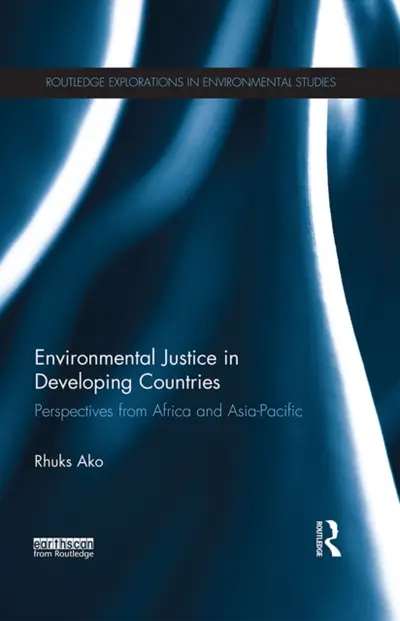
Environmental Justice in Developing Countries
Perspectives from Africa and Asia-Pacific
Price and availability
$68.99
Available in: Andorra, Austria, Australia, Belgium, Bulgaria, Canada, Switzerland, Cyprus, Czechia, Germany, Denmark, Estonia, Spain, Finland, France, United Kingdom, Guernsey, Greece, Croatia, Hungary, Ireland, Isle of Man, Iceland, Italy, Jersey, Japan, Liechtenstein, Lithuania, Luxembourg, Latvia, Monaco, Malta, Netherlands, Norway, Poland, Portugal, Romania, Sweden, Slovenia, Slovakia, San Marino, United States, Vatican City, South Africa
Stores: US, UK, Canada, EU, Australia.
Sign in to buyThe price is re-checked by the server before payment.
For personal use under the eBook licence.
- Format
- DRM
- Not stated by the publisher
- Language
- English
- Publisher
- Taylor & Francis
- Published
- 15 August 2013
- ISBN
- 9781135956189
- Subjects
- Central government policies, Development economics & emerging economies, Environmental economics, Environment law, Applied ecology, India, Nigeria, Republic of South Africa, Papua New Guinea, Comparative law, Environmental law, Environmental policy and protocols
About this book
The evolving environmental justice paradigm is conceptualized differently based on political, economic and historical factors. In developed countries, emphasis is placed on the role of individuals in environmental decision-making and the protection of their access to the prerequisite environmental information and capacity to challenge environmental decisions is the main focus. However, in developing countries, access to land and natural resources are considered integral elements of environmental justice paradigm. This book focuses on the conceptualization, recognition and protection of environmental justice in developing countries. It explores the situation by engaging an analytical discourse of relevant legal provisions in four case study countries including Nigeria, South Africa, India and Papua New Guinea. The comparative analysis of environmental justice in these countries present a framework within which to appreciate the conceptualization of the environmental justice paradigm
Bibliographic data © Gardners Books Ltd.