EPUB · English
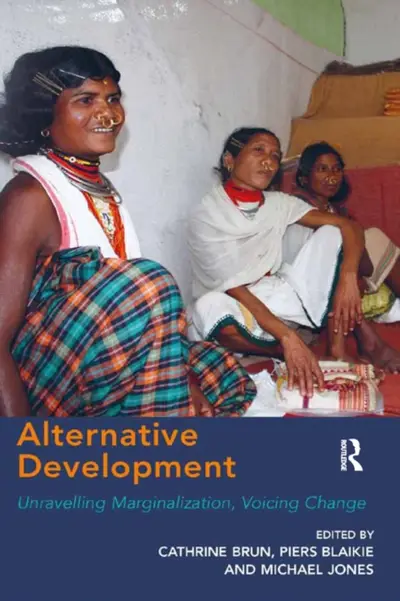
Alternative Development
Unravelling Marginalization, Voicing Change
- Society & social sciences
- Economics, business & finance
- Nature, environment & geography
- Technology & engineering
- Reference
Price and availability
$78.99
Available in: Andorra, Austria, Australia, Belgium, Bulgaria, Canada, Switzerland, Cyprus, Czechia, Germany, Denmark, Estonia, Spain, Finland, France, United Kingdom, Guernsey, Greece, Croatia, Hungary, Ireland, Isle of Man, Iceland, Italy, Jersey, Japan, Liechtenstein, Lithuania, Luxembourg, Latvia, Monaco, Malta, Netherlands, Norway, Poland, Portugal, Romania, Sweden, Slovenia, Slovakia, San Marino, United States, Vatican City, South Africa
Stores: US, UK, Canada, EU, Australia.
Sign in to buyThe price is re-checked by the server before payment.
For personal use under the eBook licence.
- Format
- EPUB
- DRM
- Not stated by the publisher
- Language
- English
- Publisher
- Taylor & Francis
- Published
- 23 March 2016
- ISBN
- 9781317182559
- Subjects
- Developing countries, Development studies, Development economics & emerging economies, Geography, Regional geography, Environmentalist thought & ideology, Applied ecology, Social impact of environmental issues, Environmental science, engineering & technology, Global South / Developing countries, Development studies, Migration, immigration and emigration, Climate change
About this book
This book brings together a collection of essays that discuss alternative development and its relevance for local/global processes of marginalization and change in the Global South. Alternative development questions who the producers of development knowledges and practices are, and aims at decentring development and geographical knowledge from the Anglo-American centre and the Global North. It involves resistance to dominant political-economic processes in order to further the possibilities for non-exploitative and just forms of development. By discussing how to unravel marginalization and voice change through alternative methods, actors and concepts, the book provides useful guidance on understanding the relationship between theory and practice. The main strength of the book is that it calls for a central role for alternative development in the current development discourse, most notably related to justice, rights, globalization, forced migration, conflict and climate change. The book provides new ways of engaging with alternative development thinking and making development alternatives relevant.
Bibliographic data © Gardners Books Ltd.