PDF · English
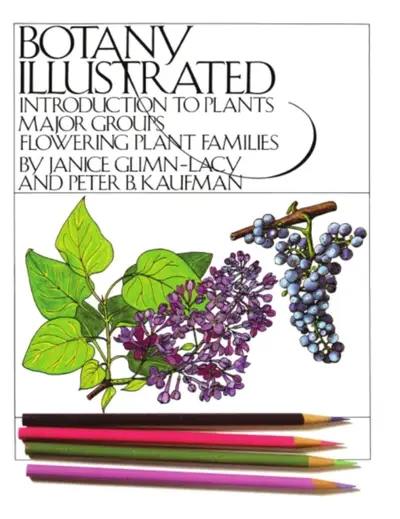
Botany Illustrated
Introduction to Plants, Major Groups, Flowering Plant Families
Price and availability
$97.99
Available in: Andorra, Austria, Australia, Belgium, Bulgaria, Canada, Switzerland, Cyprus, Czechia, Germany, Denmark, Estonia, Spain, Finland, France, United Kingdom, Guernsey, Greece, Croatia, Hungary, Ireland, Isle of Man, Iceland, Italy, Jersey, Japan, Liechtenstein, Lithuania, Luxembourg, Latvia, Monaco, Malta, Netherlands, Norway, Poland, Portugal, Romania, Sweden, Slovenia, Slovakia, San Marino, United States, Vatican City, South Africa
Stores: US, UK, Canada, EU, Australia.
Sign in to buyThe price is re-checked by the server before payment.
For personal use under the eBook licence.
- Format
- DRM
- Not stated by the publisher
- Language
- English
- Publisher
- Springer Netherlands
- Published
- 6 December 2012
- ISBN
- 9789400955349
- Subjects
- Biochemistry, Plant physiology, Plant biology
About this book
This is a discovery book about plants. It is for students In the first section, introduction to plants, there are sev- of botany and botanical illustration and everyone inter- eral sources for various types of drawings. Hypotheti- ested in plants. Here is an opportunity to browse and cal diagrams show cells, organelles, chromosomes, the choose subjects of personal inter. est, to see and learn plant body indicating tissue systems and experiments about plants as they are described. By adding color to with plants, and flower placentation and reproductive the drawings, plant structures become more apparent structures. For example, there is no average or stan- and show how they function in life. The color code dard-looking flower; so to clearly show the parts of a clues tell how to color for definition and an illusion of flower (see 27), a diagram shows a stretched out and depth. For more information, the text explains the illus- exaggerated version of a pink (Dianthus) flower (see trations. The size of the drawings in relation to the true 87). A basswood (Tifia) flower is the basis for diagrams size of the structures is indicated by X 1 (the same size) of flower types and ovary positions (see 28). Another to X 3000 (enlargement from true size) and X n/n source for drawings is the use of prepared microscope (reduction from true size). slides of actual plant tissues.
Bibliographic data © Gardners Books Ltd.