PDF · English
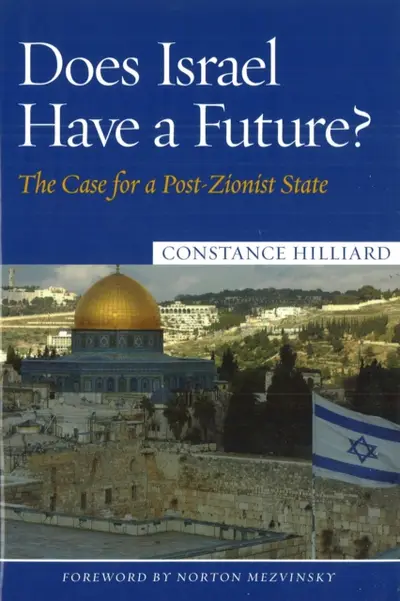
Does Israel Have a Future?
The Case for a Post-Zionist State
Price and availability
Not sold in this region
Available in: Andorra, Austria, Australia, Belgium, Bulgaria, Switzerland, Cyprus, Czechia, Germany, Denmark, Estonia, Spain, Finland, France, United Kingdom, Guernsey, Greece, Croatia, Hungary, Ireland, Isle of Man, Iceland, Italy, Jersey, Japan, Liechtenstein, Lithuania, Luxembourg, Latvia, Monaco, Malta, Netherlands, Norway, Poland, Portugal, Romania, Sweden, Slovenia, Slovakia, San Marino, Vatican City, South Africa
Stores: UK, EU, Australia. Not available in the United States store.
This title cannot be bought in this store yet: its supplier terms, territorial rights or price are still being confirmed.
For personal use under the eBook licence.
- Format
- DRM
- Not stated by the publisher
- Language
- English
- Publisher
- University of Nebraska Press
- Published
- 1 June 2011
- ISBN
- 9781597976404
- Subjects
- Middle East, Israel, Middle Eastern history, International relations, Israel, International relations, Warfare and defence, Middle Eastern history
About this book
The Jewish people are in greater danger than ever before. Given the debacle in Iraq, many Americans who had not taken a serious interest in the Middle East have begun asking themselves, What are we doing wrong? Why do we keep misreading the signals coming from that part of the world? More fundamentally, where will Israel be in two, five, ten years from now? Should Zionism be replaced by a post-Zionist state that welcomes all people, rather than one that privileges only the Jews? Will there even be a Jewish state? These are the questions Constance Hilliard addresses in Does Israel Have a Future?, forgoing polemics and wishful thinking for straight talk and painful truths. In this thoroughly researched book, Hilliard presents an honest assessment of the Jewish state's chances for survival given the forces ranged against it. The discussions about the future of the Jewish state analyzed in this book are some of the most significant to engage Israelis since 1948, dominating the airwaves, newspapers, and cafe conversations. Distilling these disparate views into a simple, straightforward exploration of one of the most explosive issues of our time-one into which few people outside Israel have delved as deeply as Hilliard has-the author presents a provocative argument that will appeal to scholars and students of international affairs, political science, and the Middle East, as well as general readers concerned about Israel's future.
Bibliographic data © Gardners Books Ltd.