PDF · English
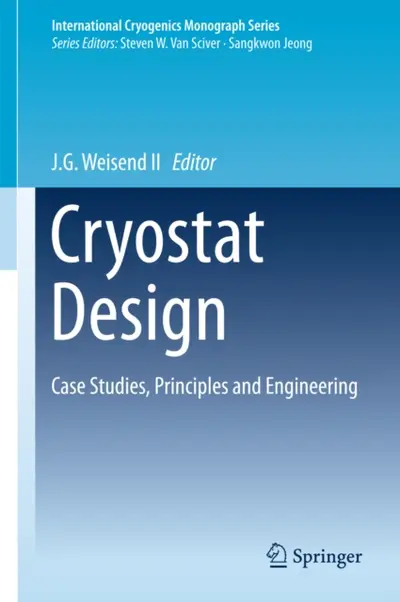
Cryostat Design
Case Studies, Principles and Engineering
Price and availability
$215.99
Available in: Andorra, Austria, Australia, Belgium, Bulgaria, Canada, Switzerland, Cyprus, Czechia, Germany, Denmark, Estonia, Spain, Finland, France, United Kingdom, Guernsey, Greece, Croatia, Hungary, Ireland, Isle of Man, Iceland, Italy, Jersey, Japan, Liechtenstein, Lithuania, Luxembourg, Latvia, Monaco, Malta, Netherlands, Norway, Poland, Portugal, Romania, Sweden, Slovenia, Slovakia, San Marino, United States, Vatican City, South Africa
Stores: US, UK, Canada, EU, Australia.
Sign in to buyThe price is re-checked by the server before payment.
For personal use under the eBook licence.
- Format
- DRM
- Not stated by the publisher
- Language
- English
- Publisher
- Springer International Publishing
- Published
- 12 August 2016
- ISBN
- 9783319311500
- Subjects
- Low temperature physics, Condensed matter physics (liquid state & solid state physics), Thermodynamics & heat, Nuclear physics, Technical design, Hydraulics & pneumatics, Low temperature physics, Particle and high-energy physics, Technical design, Engineering thermodynamics
About this book
This book enables the reader to learn the fundamental and applied aspects of practical cryostat design by examining previous design choices and resulting cryostat performance. Through a series of extended case studies the book presents an overview of existing cryostat design covering a wide range of cryostat types and applications, including the magnet cryostats that comprise the majority of the Large Hadron Collider at CERN, space-borne cryostats containing sensors operating below 1 K, and large cryogenic liquid storage vessels. It starts with an introductory section on the principles of cryostat design including practical data and equations. This section is followed by a series of case studies on existing cryostats, describing the specific requirements of the cryostat, the challenges involved and the design choices made along with the resulting performance of the cryostat. The cryostat examples used in the studies are chosen to cover a broad range of cryostatapplications and the authors of each case are leading experts in the field, most of whom participated in the design of the cryostats being described. The concluding chapter offers an overview of lessons learned and summarises some key hints and tips for practical cryostat design. The book will help the reader to expand their knowledge of many disciplines required for good cryostat design, including the cryogenic properties of materials, heat transfer and thermal insulation, instrumentation, safety, structures and seals.
Bibliographic data © Gardners Books Ltd.