PDF · English
Planning for Small Town Change
Price and availability
$78.99
Available in: Andorra, Austria, Australia, Belgium, Bulgaria, Canada, Switzerland, Cyprus, Czechia, Germany, Denmark, Estonia, Spain, Finland, France, United Kingdom, Guernsey, Greece, Croatia, Hungary, Ireland, Isle of Man, Iceland, Italy, Jersey, Japan, Liechtenstein, Lithuania, Luxembourg, Latvia, Monaco, Malta, Netherlands, Norway, Poland, Portugal, Romania, Sweden, Slovenia, Slovakia, San Marino, United States, Vatican City, South Africa
Stores: US, UK, Canada, EU, Australia.
Sign in to buyThe price is re-checked by the server before payment.
For personal use under the eBook licence.
- Format
- DRM
- Not stated by the publisher
- Language
- English
- Publisher
- Taylor & Francis
- Published
- 17 February 2017
- ISBN
- 9781317686019
- Subjects
- City & town planning - architectural aspects, Human geography, Urban & municipal planning, England, Public administration / Public policy, Urban and municipal planning and policy
About this book
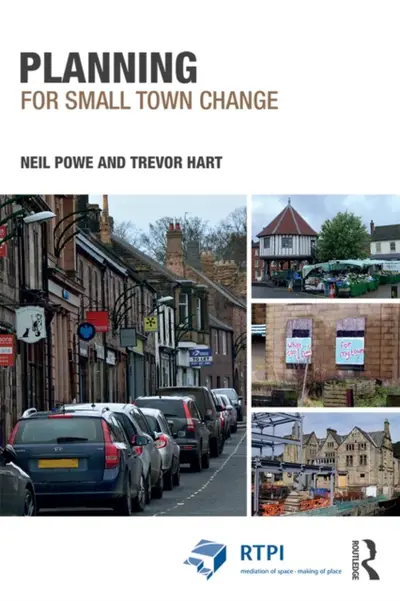
Change is inevitable in all communities: they both grow and decline. Planning is a means by which we have sought to manage this change. It has not always succeeded in providing the types of settlements and environments which many residents and others want, either because it is operating with the wrong policies or because it is failing to ensure that the right policies are effectively implemented. These failings have opened planning to criticism by a dominant neoliberal orthodoxy which shapes an increasingly difficult environment in which planning has to operate. Planning for Small Town Change builds on an underexploited selection of international research and the authors' English case studies to consider the efficacy of planning for change. Drawing on insightful small town experiences, three themes emerge: understanding and conceptualising change; appreciating the potential within place; and the mechanisms for planning and delivery. The research draws on many examples of how key actors have made a significant difference to specific places and provides important insights into how the planning process can be better matched to the long-term and complex challenges faced. Whilst small town experiences are often neglected, they are found to be particularly insightful in understanding the potential roles of local communities and the importance of place quality when planning for change.
Bibliographic data © Gardners Books Ltd.