EPUB · English
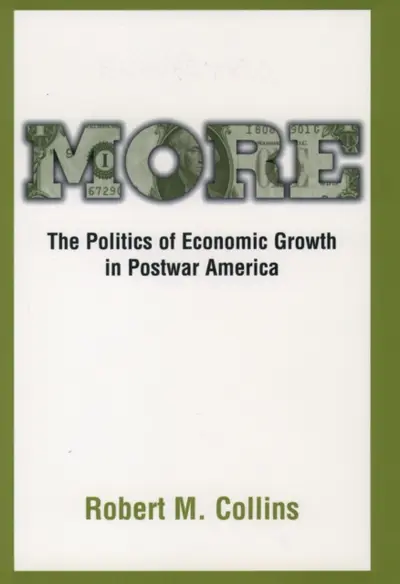
More
The Politics of Economic Growth in Postwar America
Price and availability
$31.99
Available in: Andorra, Austria, Australia, Belgium, Bulgaria, Canada, Switzerland, Cyprus, Czechia, Germany, Denmark, Estonia, Spain, Finland, France, United Kingdom, Guernsey, Greece, Croatia, Hungary, Ireland, Isle of Man, Iceland, Italy, Jersey, Japan, Liechtenstein, Lithuania, Luxembourg, Latvia, Monaco, Malta, Netherlands, Norway, Poland, Portugal, Romania, Sweden, Slovenia, Slovakia, San Marino, United States, Vatican City, South Africa
Stores: US, UK, Canada, EU, Australia.
Sign in to buyThe price is re-checked by the server before payment.
For personal use under the eBook licence.
- Format
- EPUB
- DRM
- Not stated by the publisher
- Language
- English
- Publisher
- Oxford University Press
- Published
- 4 April 2002
- ISBN
- 9780190288266
- Subjects
- USA, c 1945 to c 2000 (Post-war period), History of the Americas, 20th century history: c 1900 to c 2000, Political science & theory, Political leaders & leadership, Economic history, United States of America, USA, 3MPQ, Political science and theory, Political leaders and leadership, Economic history, NH, NHK
About this book
James Carville famously reminded Bill Clinton throughout 1992 that "e;it's the economy, stupid."e; Yet, for the last forty years, historians of modern America have ignored the economy to focus on cultural, social, and political themes, from the birth of modern feminism to the fall of the Berlin Wall. Now a scholar has stepped forward to place the economy back in its rightful place, at the center of his historical narrative. In More, Robert M. Collins reexamines the history of the United States from Franklin Delano Roosevelt to Bill Clinton, focusing on the federal government's determined pursuit of economic growth. After tracing the emergence of growth as a priority during FDR's presidency, Collins explores the record of successive administrations, highlighting both their success in fostering growth and its partisan uses. Collins reveals that the obsession with growth appears not only as a matter of policy, but as an expression of Cold War ideology--both a means to pay for the arms build-up and proof of the superiority of the United States' market economy. But under Johnson, this enthusiasm sparked a crisis: spending on Vietnam unleashed runaway inflation, while the nation struggled with the moral consequences of its prosperity, reflected in books such as John Kenneth Galbraith's The Affluent Society and Rachel Carson's Silent Spring. More continues up to the end of the 1990s, as Collins explains the real impact of Reagan's policies and astutely assesses Clinton's "e;disciplined growthmanship,"e; which combined deficit reduction and a relaxed but watchful monetary policy by the Federal Reserve. Writing with eloquence and analytical clarity, Robert M. Collins offers a startlingly new framework for understanding the history of postwar America.
Bibliographic data © Gardners Books Ltd.