EPUB · English
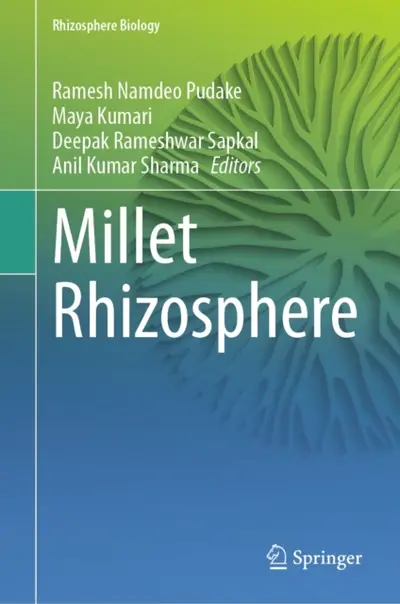
Millet Rhizosphere
Price and availability
$297.99
Available in: Andorra, Austria, Australia, Belgium, Bulgaria, Canada, Switzerland, Cyprus, Czechia, Germany, Denmark, Estonia, Spain, Finland, France, United Kingdom, Guernsey, Greece, Croatia, Hungary, Ireland, Isle of Man, Iceland, Italy, Jersey, Japan, Liechtenstein, Lithuania, Luxembourg, Latvia, Monaco, Malta, Netherlands, Norway, Poland, Portugal, Romania, Sweden, Slovenia, Slovakia, San Marino, United States, Vatican City, South Africa
Stores: US, UK, Canada, EU, Australia.
Sign in to buyThe price is re-checked by the server before payment.
For personal use under the eBook licence.
- Format
- EPUB
- DRM
- Not stated by the publisher
- Language
- English
- Publisher
- Springer Nature Singapore
- Published
- 11 September 2023
- ISBN
- 9789819921669
- Subjects
- Microbiology (non-medical), Botany & plant sciences, Soil science, sedimentology, Agricultural science, Agronomy & crop production, Microbiology (non-medical), Plant biology, Agricultural science, Soil science and management, Agronomy and crop production
About this book
This edited volume is the first book that explicitly explains the link between the extraordinarily small-scale microbial processes and the growth and yield attributes of millet crops. This book includes chapters emphasizing on the effects of rhizosphere biology on long-term millet crop management. Millets are a collection of small-grained cereal grasses that are grown for human carbohydrate needs. They are among the oldest crops, mainly divided into two groups: major and small millets based on seed size. Major millets are composed of sorghum (Sorghum bicolor) and pearl millet (Pennisetum glaucum); while small millets are composed of six species that includes finger millet (Eleusine coracana (L.)), little millet (Panicum sumatrense), kodo millet (Paspalum scrobiculatum (L.)), foxtail millet (Setaria italica (L.)), barnyard millet (Echinochloa frumentacea (L.)), and proso millet (Panicum miliaceum (L.). These crops are earlier considered as orphan crops, but recently due to their nutritional values it is gaining the importance. Various reports are published based on role of rhizosphere on growth and health of these crops. The rhizosphere being a dynamic interface among the plant roots and soil microbes provides a number of advantages to the millets too. The soil properties in rhizospheric region are also different as compared to the bulk soil. This book discovers the functional attributes of rhizosphere in promoting the healthy growth of millet crop and achieving higher yield during the changing climatic condition. This book is of interest to university teachers, scientists working in the millets, and policymakers in agricultural departments. Also, the book serves as additional reading material for undergraduate and graduate students of agriculture, biotechnology, microbiology, genetics, and soil science.
Bibliographic data © Gardners Books Ltd.