PDF · root
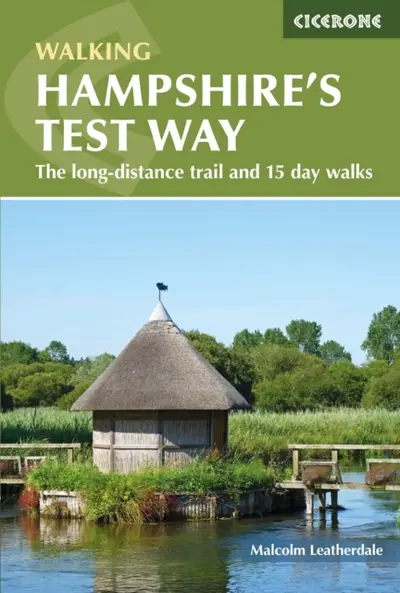
Walking Hampshire's Test Way
The long-distance trail and 15 day walks
Price and availability
$20.99
Available in: Andorra, Austria, Australia, Belgium, Bulgaria, Canada, Switzerland, Cyprus, Czechia, Germany, Denmark, Estonia, Spain, Finland, France, United Kingdom, Guernsey, Greece, Croatia, Hungary, Ireland, Isle of Man, Iceland, Italy, Jersey, Japan, Liechtenstein, Lithuania, Luxembourg, Latvia, Monaco, Malta, Netherlands, Norway, Poland, Portugal, Romania, Sweden, Slovenia, Slovakia, San Marino, United States, Vatican City, South Africa
Stores: US, UK, Canada, EU, Australia.
Sign in to buyThe price is re-checked by the server before payment.
For personal use under the eBook licence.
- Format
- DRM
- Not stated by the publisher
- Language
- root
- Publisher
- Cicerone Press
- Published
- 3 December 2024
- Pages
- 160
- ISBN
- 9781783626571
- Subjects
- South & South East England, Walking, hiking, trekking, Travel & holiday guides, SZC, Travel and holiday guides
About this book
Guidebook to walking Hampshire's Test Way, a 44 mile (71km) route from Inkpen Beacon to the Eling Tide Mill near Southampton Water. The walk, which is described over eight stages, takes in many of the region's natural, historical and architectural delights, from the ever famous 'Sprat and Winkle' railway to the River Test itself - a stunning example of the exceedingly rare chalk stream.Each stage (they range in length from 3 to 8.5 miles) is described clearly and concisely, and is accompanied by 1:50,000 OS mapping. Worth its weight in your backpack, the guide also includes information on the history, geology and landscape of the Test Valley, as well as practical information on accommodation and transport. Additionally, it describes 15 circular walks in the Test Valley, which vary in length from 3.75 miles (6km) to 8.5 miles (13.75km).The Test Way passes through areas of intriguing history and remarkable natural beauty. There are sites of Special Scientific Interest (SSSI) and Areas of Outstanding Natural Beauty (AONB) as well as Iron Age hill forts, medieval churches, age old abbeys, relics from a long passed railway era and quaint villages brimming with thatch and flint and individual 'hostelries' to match. It is a walk well suited to history and geology enthusiasts, and certainly a must for anyone interested in the iconic Sprat and Winkle railway.
Bibliographic data © Gardners Books Ltd.