PDF · English
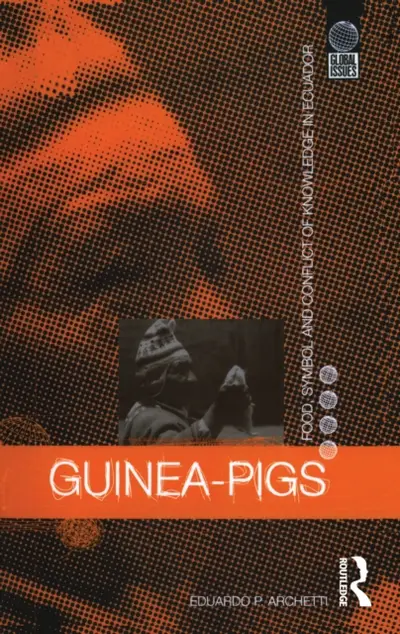
Guinea Pigs
Food, Symbol and Conflict of Knowledge in Ecuador
Price and availability
$56.99
Available in: Andorra, Austria, Australia, Belgium, Bulgaria, Canada, Switzerland, Cyprus, Czechia, Germany, Denmark, Estonia, Spain, Finland, France, United Kingdom, Guernsey, Greece, Croatia, Hungary, Ireland, Isle of Man, Iceland, Italy, Jersey, Japan, Liechtenstein, Lithuania, Luxembourg, Latvia, Monaco, Malta, Netherlands, Norway, Poland, Portugal, Romania, Sweden, Slovenia, Slovakia, San Marino, United States, Vatican City, South Africa
Stores: US, UK, Canada, EU, Australia.
Sign in to buyThe price is re-checked by the server before payment.
For personal use under the eBook licence.
- Format
- DRM
- Not stated by the publisher
- Language
- English
- Publisher
- Taylor & Francis
- Published
- 20 August 2020
- ISBN
- 9781000325621
- Subjects
- Ecuador, Cultural studies, Anthropology, Ecuador: Andean region, Development studies, Cultural studies: food and society, Social and cultural anthropology
About this book
Guinea pigs have been reared and eaten by indigenous people in the Andes since ancient times, and it seemed rational to development planners to 'modernize' their production. When these development projects ran into trouble, a team of anthropologists was invited to study the reasons for this lack of success. This intriguing book is the product of that study.What the author shows is that guinea pigs have a meaning in the social and ritual life of Ecuadorian peasants which is far from mundane. Rejecting the attempts of some anthropologists to reduce the production of guinea pigs and the festive life of the Andean community to a quest for protein, he explores the full complex of social and cultural practices which centre on this animal, and uses his study of its role within Andean culture to provide telling insights into how that culture itself is constituted -- its values, beliefs and attitudes. By working in a variety of communities with different ecological and ethnographic characteristics, the author has made a major contribution to ethnographic accounts of Ecuador and to the more general study of ritual, consumption and indigenous knowledge. He points us, in particular, towards the importance of the knowledge of women, who are those principally responsible for the care of an animal which is prized for its role in healing and central to Andean sociality. The book not only presents us with a colourful description of the range of cultural practices surrounding the guinea pig, ranging from the way the animals are reared, through a rich and complex cuisine, to their role in ritual life, but also highlights the way the gender dimension is central to understanding resistances to 'modernization' and the power of 'experts'.
Bibliographic data © Gardners Books Ltd.