EPUB · English
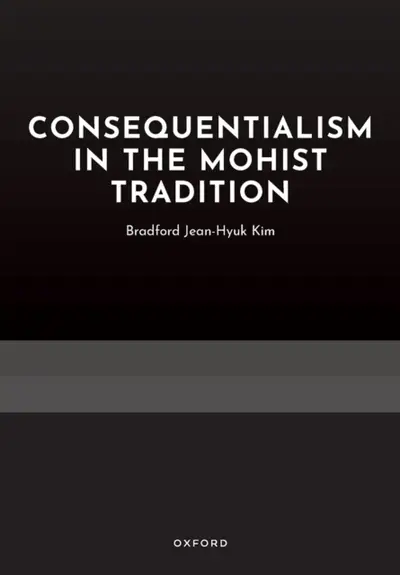
Consequentialism in the Mohist Tradition
Price and availability
$55.99
Available in: Andorra, Austria, Australia, Belgium, Bulgaria, Canada, Switzerland, Cyprus, Czechia, Germany, Denmark, Estonia, Spain, Finland, France, United Kingdom, Guernsey, Greece, Croatia, Hungary, Ireland, Isle of Man, Iceland, Italy, Jersey, Japan, Liechtenstein, Lithuania, Luxembourg, Latvia, Monaco, Malta, Netherlands, Norway, Poland, Portugal, Romania, Sweden, Slovenia, Slovakia, San Marino, United States, Vatican City, South Africa
Stores: US, UK, Canada, EU, Australia.
Sign in to buyThe price is re-checked by the server before payment.
For personal use under the eBook licence.
- Format
- EPUB
- DRM
- Not stated by the publisher
- Language
- English
- Publisher
- Oxford University Press
- Published
- 20 October 2026
- ISBN
- 9780197909546
- Subjects
- Oriental & Indian philosophy, Ethics & moral philosophy, Social & political philosophy, East Asian and Indian philosophy, Ethics and moral philosophy, Social and political philosophy
About this book
Master Mo or Mozi presents a rival tradition to that of the Confucians during the latter tradition's early development in the tumultuous Warring States period (479-221 BCE). Though Confucian thought would go on to dominate East Asia, whereas Mohist thought faded into obscurity for over two thousand years, the Mohists had an immense impact. The general consensus is that it is largely because of having to respond to Mohist criticism that Confucian thought gained much philosophical sophistication. And the Mozi's preservation by way of the Daoist canon might be explained by the fact that the Daoists, who would with the Confucians remain a force in China, took up the Mohist mantle of criticizing Confucian thought. Less influential yet still important, the Legalist school also adopted Mohist ideas, especially that concerning the consistent application of standards. Consequentialism in the Mohist Tradition assesses the core of Mohist thought: what is right is what benefits the world and when we benefit the world we should inclusively care. Commentators have too quickly assimilated this core to the consequentialism of Bentham and Mill, which holds that what is right is what promotes happiness and that when making happiness calculations we should count everyone as equal. This monograph contends that Mohism features a different valuation of persons than in Bentham and Mill. The early texts conceive of benefit in terms of aggregates and not individuals, indicating a prioritization of aggregates over individuals. The late texts, on the other hand, conceive of benefit in terms of individuals and not aggregates. While this later model would seem rather close to Bentham and Mill, there is a crucial divergence; whereas Bentham and Mill suggest that when we promote the good, everyone has the same weight in this calculus, Mohism does not extend such equal moral consideration to everyone. Early Mohism does not extend it to poor moral performers whereas later Mohism selectively extends it on the basis of what will benefit the world in context.
Bibliographic data © Gardners Books Ltd.