EPUB · English
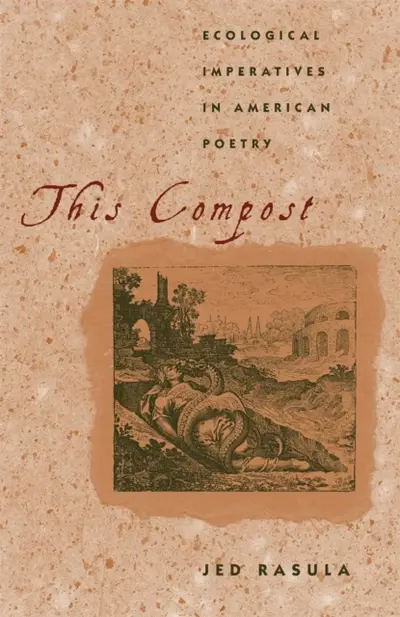
This Compost
Ecological Imperatives in American Poetry
Price and availability
$49.99
Available in: Andorra, Austria, Australia, Belgium, Bulgaria, Canada, Switzerland, Cyprus, Czechia, Germany, Denmark, Estonia, Spain, Finland, France, United Kingdom, Guernsey, Greece, Croatia, Hungary, Ireland, Isle of Man, Iceland, Italy, Jersey, Japan, Liechtenstein, Lithuania, Luxembourg, Latvia, Monaco, Malta, Netherlands, Norway, Poland, Portugal, Romania, Sweden, Slovenia, Slovakia, San Marino, United States, Vatican City, South Africa
Stores: US, UK, Canada, EU, Australia.
Sign in to buyThe price is re-checked by the server before payment.
For personal use under the eBook licence.
- Format
- EPUB
- DRM
- Not stated by the publisher
- Language
- English
- Publisher
- University of Georgia Press
- Published
- 1 September 2012
- ISBN
- 9780820344805
- Subjects
- USA, American English, c 1800 to c 1900, 20th century, Literary studies: general, Literary studies: c 1800 to c 1900, Literary studies: from c 1900 -, Literary studies: poetry & poets, The environment, United States of America, USA, 2ACBK, 3MN, 3MP, Literary studies: general, Literary studies: c 1800 to c 1900, Literary studies: c 1900 to c 2000, Literary studies: poetry and poets, The environment
About this book
Poetry, for Jed Rasula, bears traces of our entanglement with our surroundings, and these traces define a collective voice in modern poetry independent of the more specific influences and backgrounds of the poets themselves. In This Compost Rasula surveys both the convictions asserted by American poets and the poetics they develop in their craft, all with an eye toward an emerging ecological worldview.Rasula begins by examining poets associated with Black Mountain College in the 1950s-Charles Olson, Robert Creeley, and Robert Duncan-and their successors. But This Compost extends to include earlier poets like Robinson Jeffers, Ezra Pound, Louis Zukofsky, Kenneth Rexroth, and Muriel Rukeyser, as well as Clayton Eshleman, Gary Snyder, Michael McClure, and other contemporary poets. Walt Whitman and Emily Dickinson also make appearances. Rasula draws this diverse group of poets together, uncovering how the past is a "e;compost"e; fertilizing the present. He looks at the heritage of ancient lore and the legacy of modern history and colonial violence as factors contributing to ecological imperatives in modern poetry.This Compost restores the dialogue between poetic language and the geophysical, biological realm of nature that so much postmodern discourse has sought to silence. It is a fully developed, carefully argued book that deals with an underrepresented element in modern American culture, where the natural world and those who write about it have been greatly neglected in contemporary literary history and theory.
Bibliographic data © Gardners Books Ltd.