PDF · English
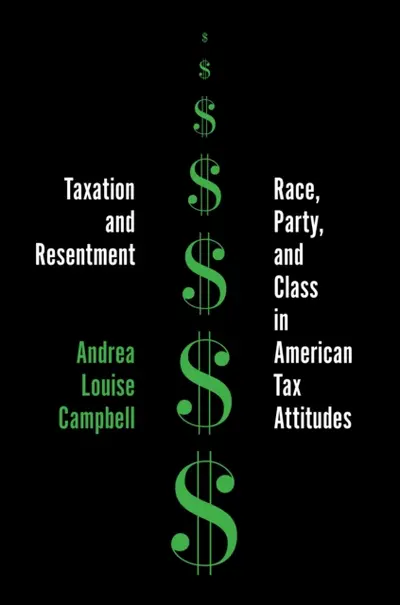
Taxation and Resentment
Race, Party, and Class in American Tax Attitudes
Price and availability
$33.99
Available in: Andorra, Austria, Australia, Belgium, Bulgaria, Canada, Switzerland, Cyprus, Czechia, Germany, Denmark, Estonia, Spain, Finland, France, United Kingdom, Guernsey, Greece, Croatia, Hungary, Ireland, Isle of Man, Iceland, Italy, Jersey, Japan, Liechtenstein, Lithuania, Luxembourg, Latvia, Monaco, Malta, Netherlands, Norway, Poland, Portugal, Romania, Sweden, Slovenia, Slovakia, San Marino, United States, Vatican City, South Africa
Stores: US, UK, Canada, EU, Australia.
Sign in to buyThe price is re-checked by the server before payment.
For personal use under the eBook licence.
- Format
- DRM
- Not stated by the publisher
- Language
- English
- Publisher
- Princeton University Press
- Published
- 10 June 2025
- ISBN
- 9780691266237
- Subjects
- USA, Social discrimination & inequality, Social classes, Ethnic minorities & multicultural studies, Political science & theory, Taxation & duties law, United States of America, USA, Racism and racial discrimination / Anti-racism, Social classes, Political science and theory, Taxation procedure
About this book
Why Americans favor progressive taxation in principle but not in practiceMost Americans support progressive taxation in principle, and want the rich to pay more. But the specific tax policies that most favor are more regressive than progressive. What is behind such a disconnect? In this book, Andrea Louise Campbell examines public opinion on taxation, exploring why what Americans favor in principle differs from what they accept in practice. Campbell shows that since the federal income tax began a century ago, the rich have fought for lower taxes through reduced rates and a complicated system of tax breaks. The resulting complexity leaves the public confused about who benefits from the convoluted tax code, and leads to tax preferences that are driven by factors other than principles or interests.Campbell argues that tax attitudes vary little by income, or by party, as some Democrats, more Republicans, and even more independents want most taxes decreased. Instead, white opinion on nearly every tax is racialized. Many do not realize the rich benefit the most from tax breaks, attitudes toward which are racialized, too. And among Black and Hispanic Americans, long subject to government coercion, greater support for government spending is not matched by greater support for taxation. Everyone has a reason to dislike taxes, which helps antitax Republicans win votesand helps the rich in their long campaign to get their own taxes reduced and undermine progressivity.
Bibliographic data © Gardners Books Ltd.