PDF · English
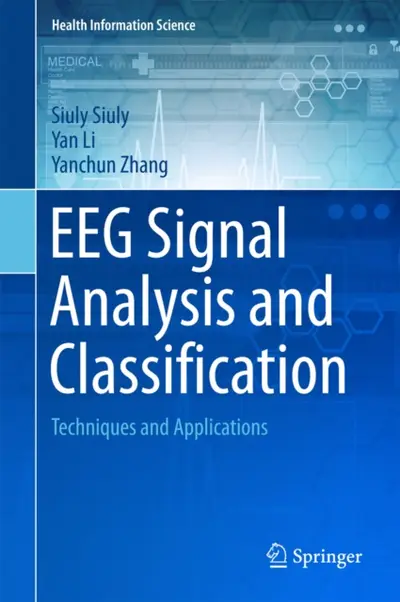
EEG Signal Analysis and Classification
Techniques and Applications
Price and availability
$161.99
Available in: Andorra, Austria, Australia, Belgium, Bulgaria, Canada, Switzerland, Cyprus, Czechia, Germany, Denmark, Estonia, Spain, Finland, France, United Kingdom, Guernsey, Greece, Croatia, Hungary, Ireland, Isle of Man, Iceland, Italy, Jersey, Japan, Liechtenstein, Lithuania, Luxembourg, Latvia, Monaco, Malta, Netherlands, Norway, Poland, Portugal, Romania, Sweden, Slovenia, Slovakia, San Marino, United States, Vatican City, South Africa
Stores: US, UK, Canada, EU, Australia.
Sign in to buyThe price is re-checked by the server before payment.
For personal use under the eBook licence.
- Format
- DRM
- Not stated by the publisher
- Language
- English
- Publisher
- Springer International Publishing
- Published
- 3 January 2017
- ISBN
- 9783319476537
- Subjects
- Medical equipment & techniques, Biomedical engineering, Artificial intelligence, Image processing, Biomedical engineering / Medical engineering, Electronics engineering, Applied computing, Computer applications in industry and technology, Artificial intelligence (AI), Computer vision, Digital signal processing (DSP)
About this book
This book presents advanced methodologies in two areas related to electroencephalogram (EEG) signals: detection of epileptic seizures and identification of mental states in brain computer interface (BCI) systems. The proposed methods enable the extraction of this vital information from EEG signals in order to accurately detect abnormalities revealed by the EEG. New methods will relieve the time-consuming and error-prone practices that are currently in use. Common signal processing methodologies include wavelet transformation and Fourier transformation, but these methods are not capable of managing the size of EEG data. Addressing the issue, this book examines new EEG signal analysis approaches with a combination of statistical techniques (e.g. random sampling, optimum allocation) and machine learning methods. The developed methods provide better results than the existing methods. The book also offers applications of the developedmethodologies that have been tested on several real-time benchmark databases.This book concludes with thoughts on the future of the field and anticipated research challenges. It gives new direction to the field of analysis and classification of EEG signals through these more efficient methodologies. Researchers and experts will benefit from its suggested improvements to the current computer-aided based diagnostic systems for the precise analysis and management of EEG signals.
Bibliographic data © Gardners Books Ltd.