EPUB · English
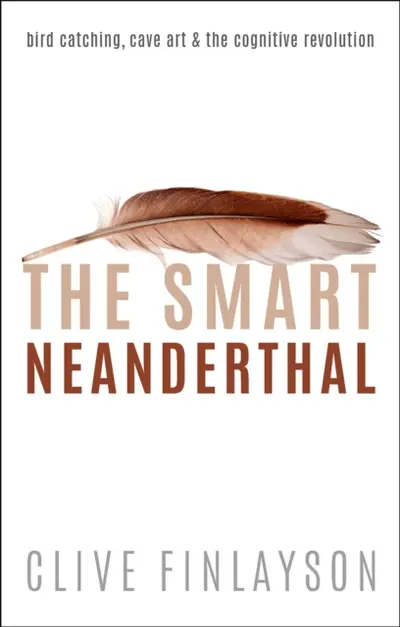
Smart Neanderthal
Bird catching, Cave Art, and the Cognitive Revolution
Price and availability
$13.99
Available in: Andorra, Austria, Australia, Belgium, Bulgaria, Canada, Switzerland, Cyprus, Czechia, Germany, Denmark, Estonia, Spain, Finland, France, United Kingdom, Guernsey, Greece, Croatia, Hungary, Ireland, Isle of Man, Iceland, Italy, Jersey, Japan, Liechtenstein, Lithuania, Luxembourg, Latvia, Monaco, Malta, Netherlands, Norway, Poland, Portugal, Romania, Sweden, Slovenia, Slovakia, San Marino, United States, Vatican City, South Africa
Stores: US, UK, Canada, EU, Australia.
Sign in to buyThe price is re-checked by the server before payment.
For personal use under the eBook licence.
- Format
- EPUB
- DRM
- Not stated by the publisher
- Language
- English
- Publisher
- Oxford University Press
- Published
- 15 February 2019
- ISBN
- 9780192518125
- Subjects
- Prehistory, Art of indigenous peoples, Archaeology, Anthropology, Popular science, Evolution, Early man, Anthropology, Archaeology, Popular science, Evolution / Evolutionary biology, Evolutionary anthropology / Human evolution
About this book
Since the late 1980s the dominant theory of human origins has been that a 'cognitive revolution' (C.50,000 years ago) led to the advent of our species, Homo sapiens. As a result of this revolution our species spread and eventually replaced all existing archaic Homo species, ultimately leading to the superiority of modern humans. Or so we thought. As Clive Finlayson explains, the latest advances in genetics prove that there was significant interbreeding between Modern Humans and the Neanderthals. All non-Africans today carry some Neanderthal genes. We have also discovered aspects of Neanderthal behaviour that indicate that they were not cognitively inferior to modern humans, as we once thought, and in fact had their own rituals and art. Finlayson, who is at the forefront of this research, recounts the discoveries of his team, providing evidence that Neanderthals caught birds of prey, and used their feathers for symbolic purposes. There is also evidence that Neanderthals practised other forms of art, as the recently discovered engravings in Gorham's Cave Gibraltar indicate. Linking all the recent evidence, The Smart Neanderthal casts a new light on the Neanderthals and the 'Cognitive Revolution'. Finlayson argues that there was no revolution and, instead, modern behaviour arose gradually and independently among different populations of Modern Humans and Neanderthals. Some practices were even adopted by Modern Humans from the Neanderthals. Finlayson overturns classic narratives of human origins, and raises important questions about who we really are.
Bibliographic data © Gardners Books Ltd.